Moses Kuria predicts run-off in 2027 presidential election
By Aloys Michael, September 28, 2025Former Senior Presidential Advisor Moses Kuria has predicted that the 2027 General Elections will be the first in which the presidency is decided in a runoff vote.
In a statement on his X on Sunday, September 28, 2025, Kuria argued that the 2027 presidential race will be so tightly contested that no candidate will secure the 50 per cent +1 majority required to win outright in the first round.
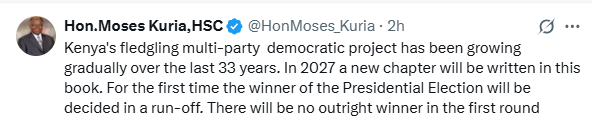
“Kenya’s fledgling multi-party democratic project has been growing gradually over the last 33 years. In 2027, a new chapter will be written in this book,” he wrote.
Also watch: Kuria claims no election will take place in 2027
“For the first time, the winner of the Presidential Election will be decided in a run-off. There will be no outright winner in the first round.”
Also watch: Maraga insists on 2027 bid, vows to restore rule of law.
Kuria’s remarks come at a time when political realignments are already taking shape, with parties and leaders quietly positioning themselves for the next race. His comments have stirred conversations about whether Kenya is ready for a run-off election, a scenario that has not occurred since the introduction of the two-round system under the 2010 Constitution.
The possibility of a run-off raises questions about coalition-building, voter turnout, and the overall conduct of elections in a highly charged political landscape.
For Kuria, however, the development would be a sign of progress in Kenya’s democratic space, showing that elections are becoming more competitive and inclusive.

The 2027 contest
Kuria’s utterances come amid growing tensions between the broad-based government and the United Opposition troops ahead of the by-elections and the 2027 polls.
For the opposition leaders, the focus is on unseating President William Ruto, whom they accuse of human rights violations, presiding over a corrupt government, and being unable to deliver tangible services to the demanding electorate.
Known for his political foresight and provocative commentary, if Kuria’s prediction holds, it would mark a historic moment for Kenya’s electoral process.
While the country’s Constitution provides for a runoff if no candidate attains the required majority, this provision has never been triggered in the past five presidential elections since the return to multi-party democracy in 1992.
The anticipated runoff would not only test Kenya’s electoral infrastructure but also reshape campaign strategies, alliances, and voter engagement in the weeks leading up to the decisive second vote.