Mombasa governor mourns the death of Kenya’s Chief Kadhi
By Aloys Michael, July 10, 2025Mombasa Governor Abdulswamad Nassir has expressed deep sorrow following the death of Kenya’s Chief Kadhi, Sheikh Abdulhalim Hussein, describing him as a devoted servant of the Kenyan Muslim community.
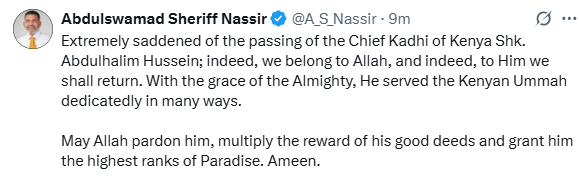
“I am extremely saddened by the passing of the Chief Kadhi of Kenya, Shk. Abdulhalim Hussein; indeed, we belong to Allah, and indeed, to Him we shall return,” the Governor said in a heartfelt condolence message on his X account on Thursday, July 10, 2025.
He praised the late Chief Kadhi’s unwavering service to the nation and the Ummah.
“With the grace of the Almighty, he served the Kenyan Ummah dedicatedly in many ways.”
As he prayed for the departed religious leader, the Governor added: “May Allah pardon him, multiply the reward of his good deeds and grant him the highest ranks of Paradise. Ameen.”
The Chief Kadhi’s death marks the end of an era of spiritual guidance and jurisprudential leadership that impacted many across Kenya’s Muslim community.
/X
Muslim community mourns
His death was announced on Wednesday, July 10, by Sheikh Jamaludin Osman, Imam at Jamia Mosque.
“Indeed, we belong to Allah, and indeed, to Him we will return. I am saddened to inform you of the passing of our Chief Kadhi, Sheikh Abdulhalim Hussein, a while ago in Mombasa. He shall be buried in Mombasa,” Sheikh Osman said.
Sheikh Abdulhalim was appointed as Kenya’s Chief Kadhi in July 2023 after a recruitment process led by the Judicial Service Commission.
He was selected from a pool of five candidates who had been shortlisted following a vacancy announcement made in April 2023.
He succeeded Sheikh Ahmed Muhdhar, who retired after serving for 12 years and attaining the age of 60.
At the time of his appointment, the JSC said: “Following deliberations and careful consideration of various candidates, JSC has appointed Hon. Athman Abdulhalim Hussein as the new Chief Kadhi of the Republic of Kenya.”
The role of Chief Kadhi is a constitutional position within the Judiciary and is reserved for Muslims who meet specific qualifications, including holding a degree in Islamic Law, being of good conduct according to Islamic principles, and being members of recognised Islamic associations.