Kenya approves duty-free rice imports to protect consumers and support farmers
By Nancy Marende, July 31, 2025The government has approved the duty-free importation of 500,000 metric tonnes of Grade 1 milled white rice to cushion consumers from rising food prices and support national food security.
According to a statement released by the Agriculture and Food Authority on July 31, 2025, the Cabinet’s decision, published under Gazette Notice No. 10353 dated July 28, 2025, seeks to address the country’s growing rice deficit without undermining local farmers.
The authority stated that the country’s annual rice consumption stands at approximately 1.3 million metric tonnes, while local production accounts for just 264,000 metric tonnes, barely 20% of demand.
“The balance has traditionally been bridged through imports. However, recent global supply disruptions and price shocks have hindered access, disproportionately affecting low-income households,” read the statement in part.
Further, the government has warned that failure to act would result in food shortages or sharp price increases not just for rice, but also for other staples like maize and wheat flour.
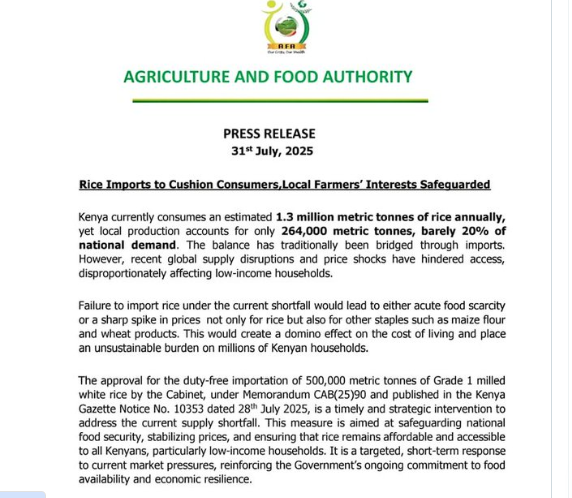
“This would create a domino effect on the cost of living and place an unsustainable burden on millions of Kenyan households,” it said.
The approved imports are a short-term intervention aimed at price stabilisation and food availability. Authorities emphasised that the measure is carefully structured to avoid market distortion.
The authority also revealed that the Kenya National Trading Corporation (KNTC) has been actively sourcing local rice directly from farmers to ensure continued support for domestic producers. KNTC has committed to maintaining a guaranteed market for locally milled rice throughout this process.
Additionally, only high-quality Grade 1 milled white rice that meets Kenyan and international safety standards will be allowed into the country, ensuring that consumer health and quality are not compromised.
The government reaffirmed its long-term commitment to boosting local production and enhancing the country’s food self-sufficiency through investments in irrigation, improved seed varieties, and market access for farmers.
The Agriculture and Food Authority (AFA) is a state corporation under section 3 of the Agriculture and Food Authority Act of 2013. The role of the Authority is to regulate, develop, and promote the value chains of scheduled crops for increased economic growth.
.