Who won the 2026 World Cup? Why Argentinians believe they were robbed
By William Muthama, July 20, 2026After defeating defending champions Argentina 1-0 in the World Cup final, Spain celebrated their second men’s title in a dramatic match filled with emotion and controversy.
The victory marked another historic achievement for Spanish football, as the team overcame the reigning champions in a tense final that required extra time to separate the two sides.
Spain’s tactical discipline, defensive organisation and ability to control key moments proved decisive as they denied Argentina the chance to retain their crown.
For Argentina, the defeat was a painful ending to a tournament where expectations were high. The team entered the final hoping to repeat their previous success, while many supporters also viewed the match as a possible final World Cup appearance for Lionel Messi.
While Spain’s victory was celebrated by their supporters as a result of tactical discipline and strong performances from their key players, some Argentina fans focused on refereeing decisions that they believe influenced the outcome.
The biggest controversy centred around the sending-off of Enzo Fernández late in normal time.
The red card that changed the final
Fernández received a second yellow card after a late challenge, leaving Argentina with 10 players for the entire extra-time period.
Many Argentina supporters argued that Enzo Fernández’s dismissal was the turning point of the final, but they disagreed over both yellow cards shown before the red.
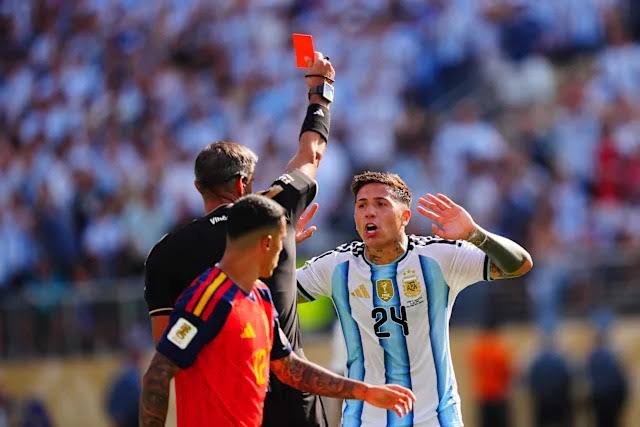
Some fans claimed the second yellow card was too harsh, arguing that the Spanish player involved in the challenge exaggerated the contact or made the situation appear worse than it was.
They felt the referee should have allowed the match to continue instead of sending Fernández off at such a crucial moment.
Others focused on the first yellow card, arguing that the initial booking was unnecessary and should never have been given.
They believe that without the first caution, Fernández would not have been facing suspension and Argentina would have entered extra time with a full squad.
Argentina coach Lionel Scaloni also expressed frustration after the final when discussing the decision. Addressing the incident, Scaloni said: “The first yellow card could have been avoided by the referee… but it is what it is.”
The coach appeared disappointed by the timing of the decision, which forced Argentina to play extra time with a numerical disadvantage. Many Argentine fans felt the red card became a turning point in the final.
However, others defended the referee’s decision, arguing that disciplinary action must be based on the challenge itself rather than the importance of the match.
Complaints over unpunished challenges
Some Argentina supporters also raised concerns over challenges they felt were not given enough attention during the match.
They argued that several strong tackles involving key Argentine players, including Lionel Messi, Julián Álvarez and Rodrigo De Paul, were not reviewed or punished in the same way as incidents involving Argentina’s own midfielders.
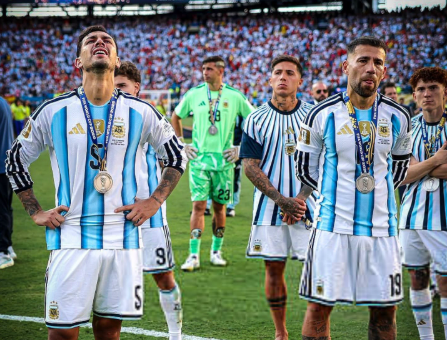
Critics claimed there was an inconsistency in how physical challenges were handled, with players such as Leandro Paredes and Enzo Fernández facing greater scrutiny for similar levels of contact.
For some Argentine fans, these moments added to the feeling that the officiating was uneven and contributed to accusations that their team was treated more harshly during the final.
However, others argued that refereeing decisions are often based on the details of each incident rather than the intensity of contact alone.
Spain’s case for victory
Despite the controversy, Spain supporters believe their team deserved the trophy because of their overall performance.
They point to Spain’s possession control, defensive organisation and ability to handle pressure throughout the tournament.
They argue that adapting to difficult situations and taking advantage of opportunities are key parts of winning at the highest level.
Spain’s younger generation, led by players such as Lamine Yamal, represented a new era of Spanish football built on technical ability, tactical intelligence and teamwork.