AIU bans Kenya’s Hillary Chepkwony for 4 years over doping
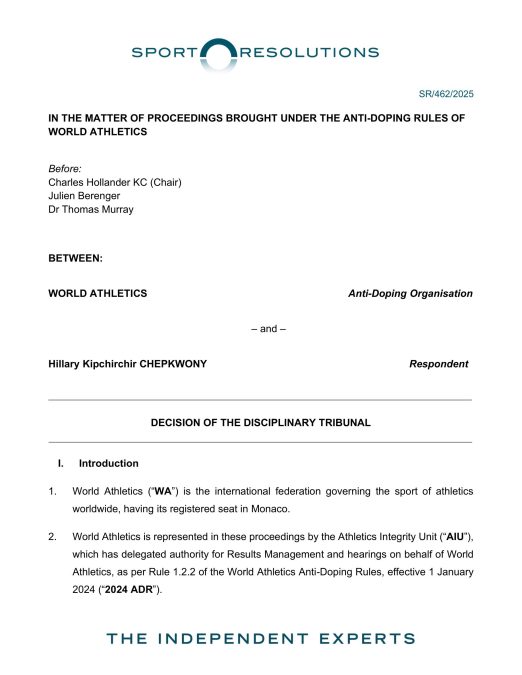
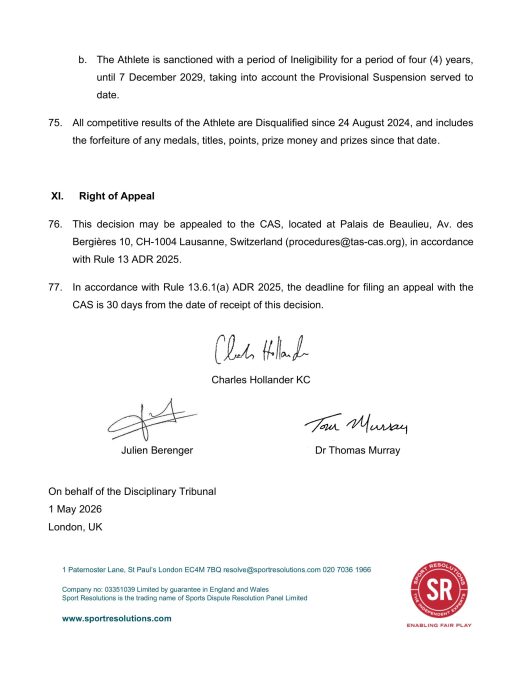
By Joel Masibo, May 12, 2026An Athletics Integrity Unit disciplinary tribunal has banned Hillary Kipchirchir Chepkwony (Kenya) for 4 years, from December 8, 2025, for the use of a prohibited substance/method (ABP case). The ban is based on the DQ results from August 24, 2024.
Hillary Kipchirchir Chepkwony is a 27-year-old long-distance runner, an international-level athlete for the purposes of the World Athletics Anti-Doping Rules (“ADR”).
According to the AIU statement released on Tuesday, May 12, 2026, on December 8, 2025, AIU served a notice of charge on the athlete. Chepkwony was charged with use of a prohibited substance or prohibited method, pursuant to Rule 2.2 2025 ADR.
Notice of charge
The AIU has stated that between September 20, 2022, and January 2, 2025, 17 blood samples were collected from the athlete in the context of the World Athletics Athlete Biological Passport (“ABP”) programme.
The ABP samples were analysed in each case by a World Anti-Doping Agency (“WADA”) accredited laboratory, and the values obtained for haematological blood values were uploaded into the Anti-Doping Administration and Management System (“ADAMS”) to constitute a longitudinal profile (the “Passport”).
The Joint Expert Panel (the “JEP”) identified abnormalities in the blood samples collected from the athlete in “Sample 14” and “Sample 15” (together, the “Samples”) collected on August 24, 2024 and August 29, 2024, respectively, and confirmed their unanimous opinion (the “First Joint Opinion”, dated May 12, 2025) that it was “highly likely” that the passport was the result of the use of a prohibited substance or prohibited method (blood doping) and “unlikely” that the Passport was the result of any other cause.
In consequence, the Athlete Passport Management Unit (“APMU”) declared an Adverse Passport Finding (“APF”) against the athlete.
On August 29, 2025, the Athlete’s legal representatives submitted their response setting out his explanation for the abnormalities detected in the Passport as referred to and relied upon by the JEP.
Following a review of the athlete’s explanation, the JEP in their “second joint opinion”, dated October 24, 2025, reasserted its unanimous opinion; notwithstanding the his explanation, all members of the JEP remained of the opinion that it was “highly likely” that the abnormal haematological pattern observed in samples 14 and 15 resulted from the use of a prohibited substance or prohibited method, and it was “highly unlikely” that it resulted from a normal physiological or pathological condition.
The athlete disputed this conclusion and denied the charge. On December 22, 2025, Chepkwony requested that the matter be determined by way of a hearing before the Disciplinary Tribunal.
Procedure
On January 5, 2026, Charles Hollander KC was appointed from the Disciplinary and Appeals Tribunal to chair the “Panel” in the present matter. Julien Berenger and Thomas Murray were subsequently appointed to the panel on April 13 and April 14, 2026, respectively. A “hearing” took place remotely via video conference on April 21, 2026.