Advertisement
Talanta Stadium: Foreign experts begin stitching synthetic fibres into natural Monaco Bermuda grass
26th August, 2026 02:42 PM
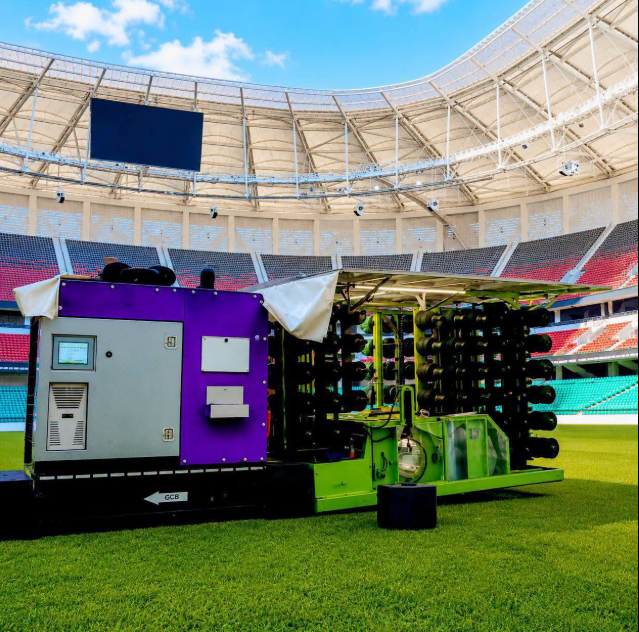
The playing surface at Nairobi’s Raila Odinga International Stadium is entering one of the most important stages of its development, with workers now undertaking synthetic stitching to reinforce the natural grass ahead of the facility’s planned use for major international matches.
The 60,000-capacity stadium, formerly known as Talanta Stadium, is being developed as one of Kenya’s flagship venues for the 2027 Africa Cup of Nations. Recent updates indicate that the main pitch has been levelled and the grass has established sufficiently for the stitching phase to begin.
What type of grass is being used?
The stadium is not relying on conventional natural turf alone. Its main pitch uses a hybrid grass system combining Monaco-variety Bermuda grass with synthetic fibres.
Sports Cabinet Secretary Salim Mvurya recently described the surface as a hybrid playing field designed to combine the characteristics of natural Bermuda grass with the additional strength provided by stitched synthetic fibres.
Earlier reports on the project referred to the technology as GrassMaster, a hybrid system in which synthetic fibres are integrated into a predominantly natural-grass playing surface. GrassMaster’s own technical description says the system uses synthetic fibres to reinforce natural grass and the underlying playing structure.
This means the pitch at Raila Odinga International Stadium should not be viewed as an artificial turf field. The playing surface remains predominantly natural grass, with synthetic fibres providing reinforcement beneath and through the turf.
What is synthetic stitching?
Synthetic stitching is the process of mechanically inserting artificial fibres into the natural-grass rootzone across the playing field.
In a GrassMaster-type system, the fibres are installed in a controlled pattern beneath the surface. As the natural grass grows, its roots intertwine around the synthetic fibres, creating a reinforced structure.
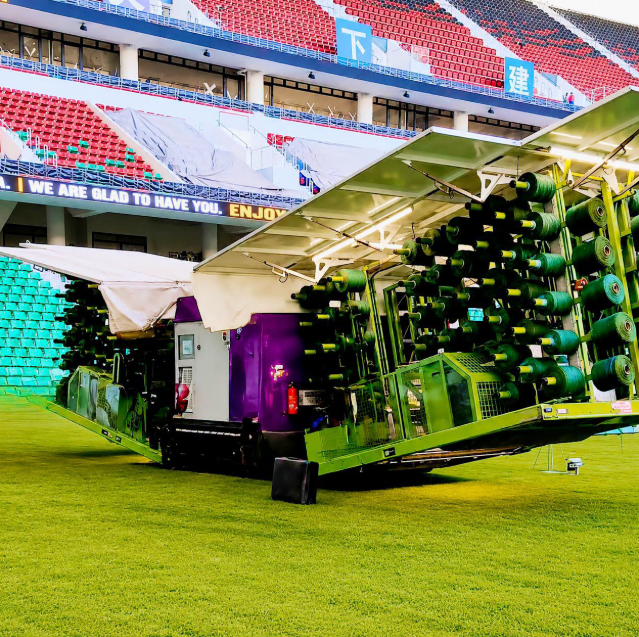
The synthetic fibres therefore act somewhat like a supporting framework for the natural turf. Technical information on GrassMaster says the fibres help stabilise the sand-based profile, provide an anchor for grass roots and maintain the uniformity and level of the playing surface.
That reinforcement is particularly important for a stadium expected to host high-level football.
Why is the stitching important?
1. It increases the pitch’s durability
Football pitches experience enormous stress during matches. Players repeatedly accelerate, stop, turn, tackle and change direction, putting considerable pressure on the turf.
A purely natural pitch can suffer from divots, worn areas and uneven surfaces when subjected to frequent use. The synthetic reinforcement helps hold the turf structure together and improves its resistance to wear.
For Raila Odinga International Stadium, that is particularly significant because the venue is being positioned as a major international football facility rather than a stadium that will only host occasional matches.
2. It improves surface stability
One of the biggest requirements of a modern elite football pitch is consistency.
The surface needs to remain relatively level so that the ball behaves predictably and players can move confidently across it. GrassMaster’s synthetic fibres are designed to help maintain the stability and uniformity of the playing surface.
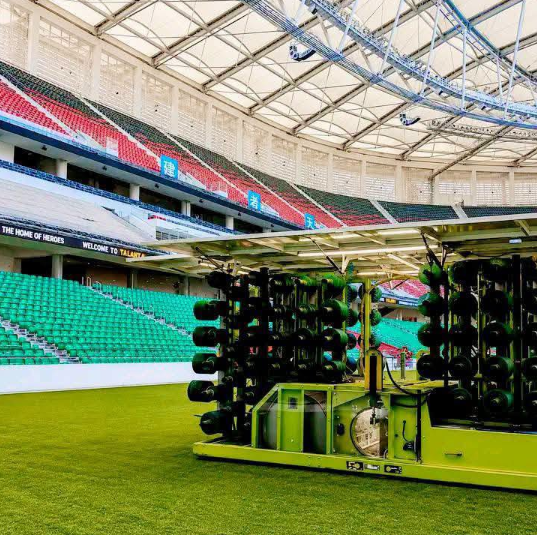
This is one reason the stitching is more than a cosmetic finishing exercise. It is part of the engineering of the playing surface.
3. It allows the stadium to cope with heavier use
A major international stadium can potentially host matches, training sessions and other events over an extended period.
Hybrid turf is designed to tolerate considerably more use than conventional natural turf while retaining the look and playing characteristics of natural grass. Industry information on GrassMaster systems indicates that such pitches can support substantially higher annual usage than conventional natural surfaces.
For Kenya, this could be particularly valuable if the new stadium becomes a regular home venue for the national team and a destination for major continental and international fixtures.
4. It protects the natural grass
The synthetic fibres do not replace the Bermuda grass. Instead, they reinforce it.
This allows the stadium to retain the playing qualities associated with natural turf while reducing the likelihood of the grass being displaced or the surface becoming badly damaged under heavy traffic.
The result is intended to be a surface that combines the natural feel of grass with greater structural resilience.
Why Monaco Bermuda grass?
Bermuda grass is widely used on sports fields in warm climates because it is suited to conditions where temperatures are relatively high.
At Raila Odinga International Stadium, the selected turf is specifically identified by officials as Monaco variety Bermuda grass. The choice forms the natural component of the hybrid system, while the synthetic fibres provide reinforcement.
The combination is therefore designed around two complementary functions: the natural grass provides the principal playing surface, while the synthetic component strengthens the turf system.
A key requirement for AFCON 2027
The quality of the pitch will be central to Kenya’s preparations for the 2027 Africa Cup of Nations, which will be jointly hosted by Kenya, Uganda and Tanzania.
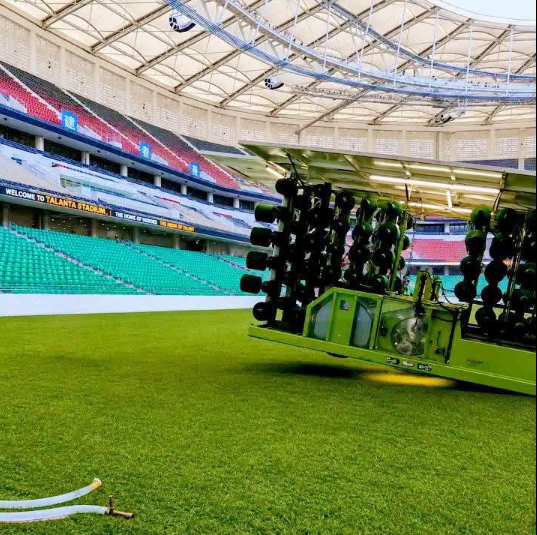
Raila Odinga International Stadium is being developed to meet CAF Category 4 requirements, making the playing surface one of the most important components of the entire facility. Government officials have repeatedly highlighted the hybrid pitch as part of the stadium’s preparation for elite football.
Recent reports indicate that the pitch is now ready for the stitching process after the grass was established.
The timing is important because the pitch will need more than simply having the synthetic fibres installed. It will also require continued turf management, including mowing, irrigation, nutrition and monitoring, to ensure the grass develops into a stable playing surface.
The stitching taking place at Raila Odinga International Stadium may appear to be a technical detail to spectators, but it could ultimately determine how well the venue performs over the long term.
For a 60,000-seat stadium intended to host some of Africa’s biggest football matches, the pitch must withstand intense use while maintaining the quality expected at international level.
The hybrid approach gives the stadium a natural-grass playing surface while adding an artificial reinforcement system underneath it. That combination is designed to provide greater durability, stability and consistency than conventional natural turf alone.
As Kenya moves closer to hosting AFCON 2027, the synthetic stitching therefore represents an important final step in transforming the pitch from a newly established grass field into a high-performance international football surface.
If properly installed and maintained, the hybrid system could become one of the defining technical features of Raila Odinga International Stadium, and an important part of Kenya’s attempt to provide a pitch capable of matching the demands of elite African football.