Gor Mahia vice chairperson questions FKF after Harambee Starlets’ WAFCON flop
By Joel Masibo, August 4, 2026Harambee Starlets’ disappointing return to the Women’s Africa Cup of Nations (WAFCON) has sparked criticism from Gor Mahia vice chairperson Sally Bolo, who has questioned not only the team’s preparations but also the Football Kenya Federation’s (FKF) decision to send what she described as an all-male delegation to support the women’s national team.
Kenya exited the tournament without a point after suffering three consecutive defeats against Morocco (4-0), Senegal (1-0,) and Algeria (2-0), and failing to score a single goal, ending their campaign at the bottom of Group A. The poor showing has triggered calls for an internal review of the team’s preparation and management.
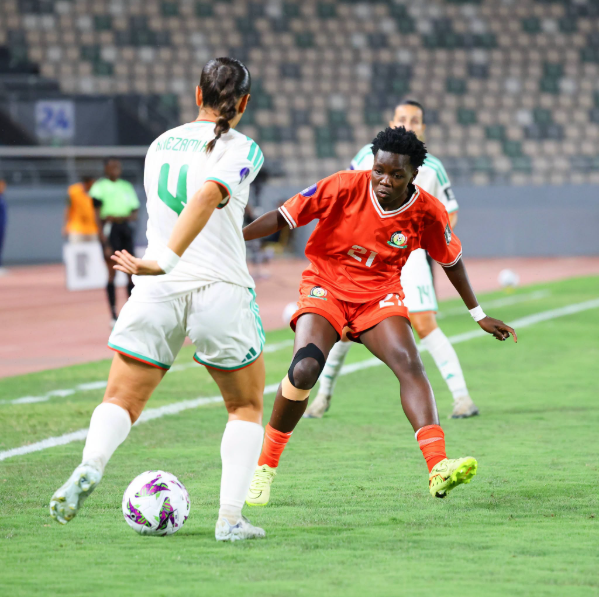
In a statement shortly after Starlets lost 2-0 to Algeria on Monday, August 3, 2026, Bolo argued that the shortcomings witnessed in Morocco began long before the opening whistle, pointing to inadequate planning, questionable squad selection and what she termed a missed opportunity to promote women in football leadership.
The Harambee Starlets delegation to the training camp in Miramas, France, for the 2026 Women’s Africa Cup of Nations (WAFCON) comprised the women’s national team and a technical and administrative bench. Public records and federation listings specific to the male delegation or Football Kenya Federation (FKF) officials accompanying this camp include administrative and technical members.
Questions over the Miramas delegation
The Starlets travelled to Miramas, France, on July 15, 2026 for their final training camp before heading to Morocco. FKF’s travelling delegation largely comprised federation president Hussein Mohammed, deputy president McDonald Mariga, senior male administrators, members of the technical bench led by head coach Beldine Odemba, and other male officials overseeing logistics and administration.
FKF’s public communications around the trip did not indicate that the federation’s elected Women’s Representative or female NEC officials were part of the official delegation.
FKF Traveling/Administrative Members included: Ahmedqadar Dabar, Abdullahi Yusuf Ibrahim, Caleb Amwayi Siboke, Yusuf Abdinasir Mohamed, Kaino Boaz Kibet, Rukia Yusuf, Molu Ali Chukulisa, and Zahro Abdikadir Ali.
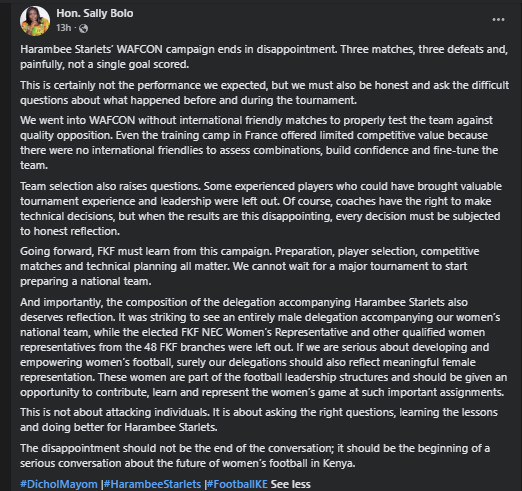
“It was striking to see an entirely male delegation accompanying our women’s national team, while the elected FKF NEC Women’s Representative and other qualified women representatives from the 48 FKF branches were left out,” Bolo said.
“If we are serious about developing and empowering women’s football, surely our delegations should also reflect meaningful female representation. These women are part of the football leadership structures and should be given an opportunity to contribute, learn and represent the women’s game at such important assignments.”
Bolo believes that omission undermined the federation’s commitment to growing the women’s game, arguing that women leaders within FKF should have been given an active role during one of the country’s biggest women’s football assignments.
Her criticism comes at a time when many stakeholders are demanding greater female representation in football governance, especially during major international tournaments involving women’s teams.
Preparation also comes under fire
Beyond the delegation, Bolo questioned the technical and logistical preparation that preceded the tournament.
She noted that the Starlets lacked sufficient international friendlies before WAFCON, saying the Miramas training camp failed to provide meaningful competitive tests that could have helped the coaching staff assess combinations and build confidence.
Her remarks differ from FKF’s position before the tournament, when the federation described the France camp as the final phase of preparations ahead of the continental championship.
Bolo also suggested that some experienced players who could have added leadership and tournament know-how were overlooked during squad selection.
“Coaches have the right to make technical decisions, but when the results are this disappointing, every decision must be subjected to honest reflection,” she said.
Call for reforms
The Gor Mahia vice chairperson insists Kenya must draw lessons from the disappointing campaign instead of treating it as an isolated failure.
She urged FKF to begin preparing national teams much earlier, invest in quality international friendlies and ensure future women’s national team delegations include female football leaders.

“This is not about attacking individuals. It is about asking the right questions, learning the lessons and doing better for Harambee Starlets,” Bolo said.
“The disappointment should not be the end of the conversation; it should be the beginning of a serious conversation about the future of women’s football in Kenya.”
Her comments are likely to intensify debate over FKF’s management of the Starlets campaign as the federation comes under increasing pressure to explain what went wrong after Kenya’s long-awaited return to Africa’s biggest women’s football tournament ended without a single point or goal.