UN warns internet restrictions threaten free and fair elections in Uganda
By Nancy Marende, January 14, 2026The United Nations Human Rights Office has warned that internet restrictions and the suspension of civil society organisations ahead of Uganda’s elections pose a serious threat to free and fair democratic processes.
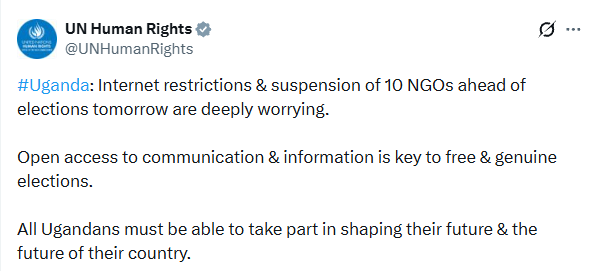
In a statement issued on Wednesday, January 14, 2026, the UN said it was deeply concerned by reports of internet restrictions and the suspension of 10 non-governmental organisations (NGOs) just days before Ugandans head to the ballot.
“Internet restrictions and the suspension of 10 NGOs ahead of elections tomorrow are deeply worrying,” the statement read in part.
The UN emphasised that open access to communication and information is a fundamental pillar of credible elections.
“Open access to communication and information is key to free and genuine elections,” the statement added.
The UN further underscored the importance of inclusive participation, stating that every Ugandan has the right to be involved in shaping the country’s political future.
“All Ugandans must be able to take part in shaping their future and the future of their country,” the statement said.
This comes a day after Uganda’s communications authority told all service providers to suspend internet access ahead of Thursday’s general election.
It justified the decision on the grounds of public safety to prevent “online misinformation, disinformation and electoral fraud… as well as preventing the incitement of violence”.
Earlier this month, the Uganda Communications Commission (UCC) described reports of an internet blackout as “mere rumours”, saying the commission’s role was to guarantee uninterrupted connectivity nationwide.
During the last election in 2021, which saw widespread protests with dozens killed, the internet was cut for at least a week.
The UCC said that the internet suspension should start from 18:00 local time (15:00 GMT) on Tuesday, January 13, 2026, but did not give a date when it would be lifted.
Users of regular mobile data have already reported that they cannot access the internet, though some business facilities, such as large hotels, continue to enjoy wireless connectivity.
Voice calls and basic SMS services are expected to remain operational.
In its letter to the mobile phone operators, the UCC said it was acting on “a strong recommendation” from the security agencies, including the army and police.
“This temporary suspension is a precautionary intervention to ensure peace, protect national stability and prevent the misuse of communication platforms during a sensitive national exercise,” the letter said.