Faith in community kingpin drops from 63% to 47% among Luos after Raila’s death — survey
By Valerian Khakayi, December 23, 2025The TIFA survey has revealed a significant decline in the recognition of ethnic-based community leadership among the Luo community following the passing of the Orange Democratic Movement (ODM) leader Raila Odinga.
According to the report released on Tuesday, December 23, 2025, many analysts have suggested that most Kenyans act as pawns of their ethnic community leaders. The survey shows that not even a majority across communities acknowledge having such a leader.
In the report, the Luo community showed a marked decline, dropping from 63% to 47%, a trend analysts attribute to the death of Raila Odinga, a figure widely seen as a central ethnic and political leader.
“While many analysts/commentators appear to believe that most Kenyans are basically ‘pawns’ of their ethnic community leaders, for the two surveys in which TIFA have posed this question, not even a majority acknowledge that their community has one (40%, 45%),” TIFA’s latest report reads.
“It has declined markedly among the Luo (from 63% to 47%), apparently as a consequence of Raila’s passing.”
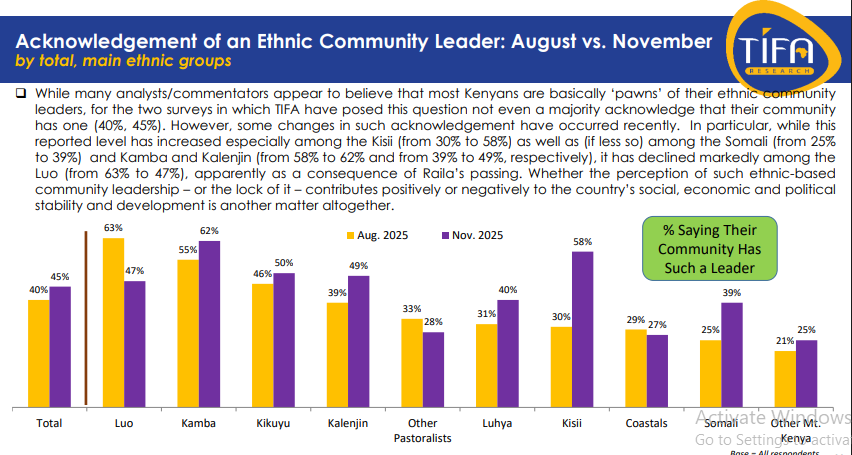
However, the level of acknowledgement has shifted across different ethnic groups. Among the Kisii, recognition of community leadership rose sharply from 30% to 58%, while the Somali community saw an increase from 25% to 39%.
Kamba and Kalenjin communities also reported modest increases, from 58% to 62% and 39% to 49%, respectively.
“Some changes in such acknowledgement have occurred recently. In particular, while this reported level has increased especially among the Kisii (from 30% to 58%) as well as (if less so) among the Somali (from 25% to 39%) and Kamba and Kalenjin (from 58% to 62% and from 39% to 49%, respectively), the TIFA report reads.
TIFA’s latest report further disclosed that whether the presence or absence of ethnic-based leadership contributes positively or negatively to Kenya’s social, economic, and political stability remains a subject of debate.
“Whether the perception of such ethnic-based community leadership – or the lock of it – contributes positively or negatively to the country’s social, economic and political stability and development is another matter altogether,” TIFA’s report reads.
This latest survey highlights how leadership perceptions continue to shape the political and social dynamics within different communities.