Advertisement
First Ferrari Purosangue arrives in Kenya: Inside the Ksh100M luxury SUV
10th September, 2026 04:13 PM
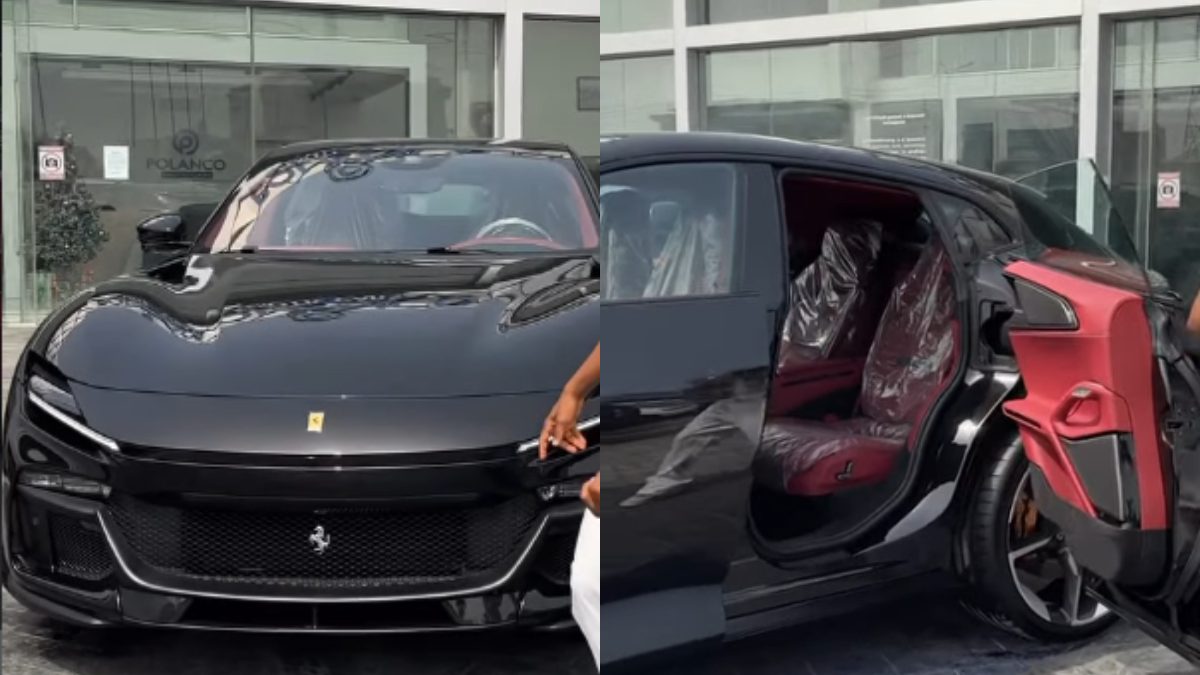
The Ferrari Purosangue, the Italian marque’s first production four-door, four-seater, has arrived in Kenya, bringing one of Ferrari’s most radical departures from its traditional sports-car formula to the local market.
The luxury high-performance vehicle is estimated to be worth more than Ksh100 million once its purchase price, shipping, customs duties and other import-related costs are factored in, placing it among the most expensive SUVs, or SUV-like vehicles, on Kenyan roads.
The arrival marks a significant moment for Ferrari enthusiasts in the country because the Purosangue is unlike almost anything the Maranello-based manufacturer had produced before it. Ferrari itself refuses to classify the vehicle as an SUV, instead presenting it as a Ferrari Utility Vehicle and describing it as a thoroughbred sports car designed to offer greater everyday usability.
Ferrari’s official specifications reveal that the Purosangue combines a 6.5-litre naturally aspirated V12 engine with all-wheel drive, four individual seats and a sophisticated active suspension system, giving it the unusual ability to combine family-car practicality with the performance of an exotic sports car.
The engine
At the heart of the Purosangue is a 6,496cc naturally aspirated V12 engine, known internally as the F140IA.
The front-mid-mounted engine produces 725 cv at 7,750rpm and 716Nm of torque at 6,250rpm, with a maximum engine speed of 8,250rpm. Crucially, Ferrari achieves these figures without a turbocharger or hybrid motor assisting the V12.
That naturally aspirated configuration is one of the car’s biggest attractions because Ferrari has retained the high-revving V12 character associated with some of its most celebrated grand tourers while placing the engine in a vehicle intended to carry four adults.
Ferrari says the engine was developed to deliver strong torque at low revs without sacrificing the linear delivery of power associated with its naturally aspirated 12-cylinder engines.
Power is sent through an eight-speed dual-clutch transmission, with the gearbox mounted at the rear in a transaxle configuration. The layout helps the Purosangue achieve a 49:51 front-to-rear weight distribution, an arrangement designed to give the vehicle the balance expected of a Ferrari sports car.
A four-door Ferrari that can outrun most sports cars
Despite its size and four-seat configuration, the Purosangue is capable of supercar-like performance.
Ferrari quotes a 0-100km/h time of 3.3 seconds and a 0-200km/h time of 10.6 seconds, while its top speed exceeds 310km/h.
For perspective, that means the vehicle can reach 100km/h from rest in roughly the time it takes some dedicated sports cars to complete the same sprint.
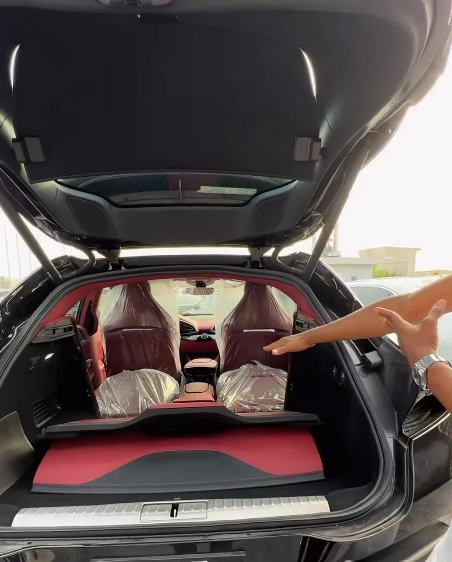
The Purosangue also has a 100-litre fuel tank and a 473-litre boot, while its rear seats can be folded to create additional luggage space.
Why Ferrari refuses to call it an SUV
One of the most intriguing aspects of the Purosangue is Ferrari’s insistence that it should not be treated as a conventional SUV.
The company has deliberately positioned the vehicle as something different from the growing crop of performance SUVs produced by manufacturers such as Lamborghini, Aston Martin and Porsche.
Its driving position is higher than that of Ferrari’s traditional sports cars, but it remains relatively low and intimate rather than adopting the commanding, upright driving position associated with conventional SUVs.
It also has no dedicated off-road driving mode, reinforcing Ferrari’s argument that its primary purpose is high-performance road driving rather than tackling difficult terrain.
The distinction is important because Ferrari entered the performance utility market without abandoning the characteristics that define its sports cars.
The unusual doors
The Purosangue is also instantly recognisable because of its rear-hinged rear doors.
Ferrari calls them “welcome doors”, and the arrangement allows passengers to enter and leave the rear seats more easily while helping the designers maintain the vehicle’s sleek proportions.
The car has four individual seats rather than a conventional rear bench, meaning each occupant gets a dedicated sports-style seat.
The interior follows a dual-cockpit philosophy, with the front passenger receiving their own large touchscreen rather than simply sharing the driver’s central information area. The cabin therefore gives the passenger a more involved experience than would normally be expected in a high-performance car.
Ferrari also fitted four heated electric seats as standard, while the vehicle offers luxury features including a Burmester audio system.
The suspension trick
Perhaps the most technically remarkable feature of the Purosangue is hidden underneath its body.
Ferrari developed a fully active suspension system using Multimatic’s True Active Spool Valve technology, with electric motors and hydraulic dampers working together to control body and wheel movement.
The system constantly monitors the car using sensors at each suspension corner and can actively control the suspension to reduce body roll and pitch while also responding to bumps and irregularities on the road.
Ferrari says the system can actively vary roll stiffness and lower the roll centre by up to 10mm, allowing the vehicle to remain composed through corners while still absorbing imperfections in the road surface.
That technology is particularly significant in Kenya, where a vehicle can encounter dramatically different road surfaces within a single journey.
Carbon-fibre roof and massive wheels
The Purosangue also uses a carbon-fibre roof as standard, helping reduce weight and lower the centre of gravity.
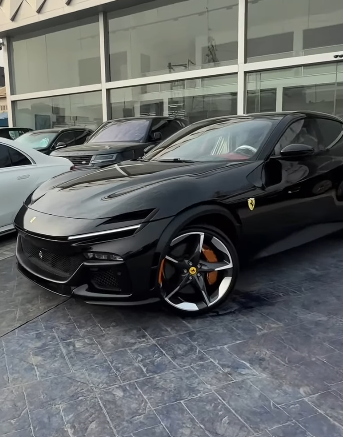
Ferrari’s technical data lists the vehicle at 4,973mm long, 2,028mm wide and 1,589mm high, with a 3,018mm wheelbase. Its dry weight is listed at 2,033kg in the specified lightweight configuration.
The vehicle rides on 22-inch front wheels and enormous 23-inch rear wheels, with 255/35 R22 tyres at the front and 315/30 R23 tyres at the rear.
The braking system is equally substantial, with 398mm front discs and 380mm rear discs.
How the Purosangue came to be
Ferrari unveiled the Purosangue in September 2022 before production began at its Maranello factory in Italy.
The model became one of the most anticipated additions to Ferrari’s range because it represented the company’s first serious attempt to enter a market dominated by vehicles such as the Lamborghini Urus and Aston Martin DBX while simultaneously refusing to call its creation an SUV.
Demand was so strong that Ferrari temporarily stopped taking new orders soon after its unveiling as it worked to manage demand.
The vehicle has since become one of the defining models in Ferrari’s modern range, and Ferrari continues to list it among its V12 range cars.
Author
Steve Ireri
Steve is a senior writer with over four years of experience in digital journalism. His focus is on the showbiz and human interest stories. Emails: [email protected] , [email protected]
View all posts by Steve Ireri