Advertisement
SRC outlines job evaluation procedure for civil servants ahead of salary increase
05th July, 2026 02:04 PM

Civil servants awaiting a fresh salary increase will first be affected by a job evaluation process that will determine the value of different positions across the public service.
The process is expected to guide the review of salaries and allowances for workers in ministries, State departments, agencies and county governments as the government implements Phase II of the Collective Bargaining Agreement (CBA).
Public Service Cabinet Secretary Geoffrey Ruku announced on Tuesday, June 23, 2026, that all public servants would receive salary adjustments from July. He said the review would cover gross pay, house allowance and commuter allowance.
However, the exact amount each employee will receive remains unclear as the Salaries and Remuneration Commission (SRC) is expected to issue new salary scales after the job evaluation exercise.
Commission to begin with public awareness
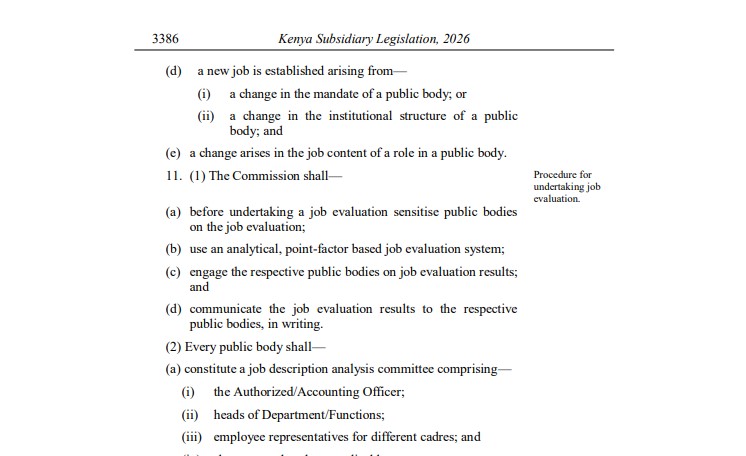
Under the procedure for undertaking job evaluation, the Commission must first sensitise public bodies before the exercise begins.
This means ministries, departments, agencies and county governments will be informed about the purpose of the evaluation, the documents required and the role each institution is expected to play.

The Commission will then use an analytical, point-factor based job evaluation system. This method assesses jobs based on factors such as the level of responsibility, skills required, decision-making powers, working conditions and the complexity of duties.
After carrying out the assessment, the Commission will engage the respective public bodies on the results before communicating the final outcome in writing.
Committees to identify jobs for review
Every public body will be required to form a job description analysis committee to support the process.
The committee must include the authorised or accounting officer, heads of departments or functions, employee representatives from different job cadres and shop stewards where applicable.
Its main role will be to assess, identify and determine the jobs that should be evaluated. It will also prepare a complete, accurate, approved and authenticated job description manual for submission to the commission.
The committee will further prepare a report on the jobs to be submitted for evaluation and provide feedback after the Commission communicates the results.
The job description manual must be aligned with the relevant laws and approved human resource instruments.
What happens when documents are not submitted
The regulations provide that where a job description for a State officer or public officer is not submitted, the Commission may use information contained in the relevant law to evaluate the position.
Where no job description is submitted for a public officer, the results of the previous job evaluation will apply.
Public bodies are also expected to give feedback on the results. If an institution does not respond, the Commission can proceed and conclude the evaluation without waiting for feedback.
Salary review and payroll reforms
This comes even as Ruku said the salary increase would apply to all public servants and would include adjustments to basic pay, housing allowance and commuter allowance.
“President William Ruto and his government are increasing the salaries of all public servants in July this year. It will be gross pay, housing allowance, and commuter allowance, which will be increased once more in July this year,” Ruku said during Public Service Week celebrations at the Kenyatta International Convention Centre (KICC).
A circular addressed to Public Service Principal Secretary Jane Imbunya referred to guidelines for negotiations under the fourth remuneration and benefits review cycle for 2025 to 2029.
The government had earlier approved a basic salary structure and leave allowance to take effect from July 1, 2025, at a cost of Ksh2.06 billion in the 2025/2026 financial year.
The latest review is expected to raise take-home pay by between Ksh1,000 and Ksh55,364 per month, depending on job group and the allowances attached to a position.
Ruku also said President William Ruto had directed ministries, State departments, agencies and county governments to move to one payroll platform, the Human Resource Information System.
Institutions that fail to comply risk having salary remittances suspended until they are integrated into the platform.