Why getting your hands dirty boosts your health within weeks
By BBC, September 12, 2026Putting our hands in soil and touching grass, trees or moss provides a wide range of health benefits, for our skin and wider immune system.
I take a long walk in my nearest park every day, almost religiously. There are plenty of different tree species to look at, an everchanging cast of fragrant flowers in spring, and enthusiastic birdsong fills the air. But the sensory experience usually stops there. However mucky my shoes get, I usually come home with clean hands.
Research, though, suggests there’s something to be said for reaching out to touch the trees, shrubs and soil I usually walk past. Mira Grönroos, an ecologist and nature-health researcher at the Finnish Environment Institute, asked people to rub their hands with soil, peat and moss for 20 seconds as part of an experiment.
She found that the abundance and variety of microbes on their skin increased, even after they rinsed their hands with tap water. “To the naked eye [their hands] looked clean,” she says, “but the change was so huge”.
The idea of more bacteria on our skin might not sound appealing. But when there’s a rich mix of microbes living alongside each other, they keep each other in check and defend us against more harmful, pathogenic bacteria.
A growing body of research shows that contact with natural materials, like soil and plants, is an easy way to boost our skin’s microbial diversity, and that this not only benefits our skin, but also our immune system.
Twenty seconds isn’t long – I’d happily pause on my walk to touch some tree bark or sit down in the grass. But more would be much better, Grönroos says, as in her experiment “the skin microbiota very quickly returned to a similar state as it was before”. The results suggest that prolonged or frequent skin contact with nature could significantly change what’s happening on our skin and in our bodies.
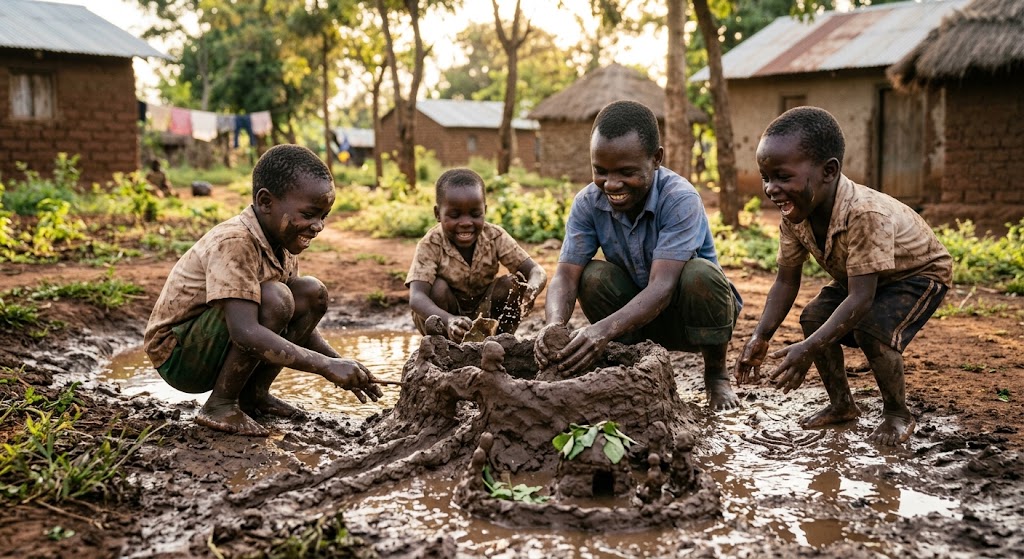
Playing in the mud
Mucky hands are the norm for children at Aurinkolinna daycare centre in central Finland. They spend at least a couple of hours every day playing outside in a wooded playground, racing between bushes and trees, climbing ropes, making sandcastles, splashing in puddles and grabbing fistfuls of dirt and woodchips.
By the end of each day they are covered head to toe in mud. Scientists are now studying how this could be good for their health. By analysing microbes on the children’s skin, saliva and faeces, alongside blood and hair samples, researchers are learning what happens to their immune systems over a three-year period when nature is brought into the yards where they play every day.
Aurinkolinna is one of 43 daycare centres in Finland taking part in the Vahvistu research project, which builds on a recent two-year study led by environmental scientist Marja Roslund.
In 2016-17, she brought the forest floor into a daycare yard – complete with peat and planting boxes – and measured the impact on young children’s skin, saliva and gut bacteria after they had played there regularly for 28 days, and again after a year. Compared to children who played in a paved yard, those on the forest floor had greater microbial diversity on their skin a year later.
This diversity is important for the health of our skin. Increasing the diversity of bacteria on the skin can prevent disease-causing bacteria from becoming dominant, keeping the microbial community in balance, Roslund says. “Disease is like a dictator, and healthy skin is like a democracy.”
Roslund’s research found fewer potential pathogens on children’s skin when they had played on the forest floor, likely because the number and diversity of other microbes crowds out these “bad” bacteria. “Because there is so much of everything else, there is not so much space for the pathogens,” she says.
Healthy skin, healthy body
Taking care of our skin also has benefits that run much deeper. Skin health can impact hormonal activity, cardiovascular disease, and even cognitive function. In particular, research is starting to show that exposing our skin to diverse bacteria can impact our immune system.
Roslund asked a group of young children to play in a sandbox enriched with microbially diverse soil, while another group played in a sandbox that looked the same but contained less microbial diversity.
As we might expect, the diversity of certain bacteria on children’s skin increased when they played in the microbially rich sandbox. But there were also changes to the immune markers, called cytokines, in these children’s blood samples that support immunoregulation – the immune system’s ability to fight off threats without becoming overactive.
It is these and similar findings that inspired the Vahvistu project. At Aurinkolinna, government funding has helped transform the yard so it now includes woodchips instead of gravel, a bigger sanded area, and wooden pathways, alongside the birch and pine trees that were already there.
The research behind the Vahvistu project supports what is known as the biodiversity hypothesis – the idea that air, plants and soil rich in diverse microbes have an important influence on the human microbiome, and therefore our health.
It has long been suggested that the loss of biodiversity in our environment could be behind the current rise in immune-related conditions, and Roslund’s research may help to explain how and why that is.
She found that one family of bacteria, namely gammaproteobacteria, plays a particularly important role. Gammaproteobacterial diversity increased on children’s skin when they played in the yard with the forest floor, and this increase was associated with more regulatory T cells – white blood cells that help control and balance the immune system and are important for preventing autoimmune diseases, she says.
For now, it’s not clear exactly what this means for immune-mediated diseases like eczema, asthma or allergies. “We cannot yet say that when you have contact with nature, you will not get asthma, for example. But it seems that it might reduce the possibility of getting those immune system disorders,” Grönroos says.