Advertisement
Wasp named after legendary wildlife broadcaster David Attenborough on his 100th birthday
09th May, 2026 01:43 PM

Scientists have named a newly identified species of wasp after David Attenborough to honour the legendary naturalist and broadcaster’s 100th birthday.
The wasp, called Attenboroughnculus tau, had been sitting in the collection of London’s Natural History Museum since 1983 after its discovery in southern Chile’s Valdivia province.
It’s not unusual for specimens to spend a long time in museum archives before being properly analysed or classified, according to Gavin Broad, principal curator of insects at London’s Natural History Museum. Broad led a study on the species that was published Thursday in the Journal of Natural History.
“Taxonomic discovery is sometimes really quick, you find something, and you describe it right away,” he said. “But sometimes it’s quite slow, and you just work methodically through the collections that other people have accumulated over the years.”
Augustijn De Ketelaere, a volunteer and study coauthor, spotted Attenboroughnculus tau during a survey of the museum’s ichneumon wasps a large and geographically widespread group of parasitic wasps that contains about 25,000 identified species, with an estimated 75,000 more yet to be named.
A detailed examination of the 43-year-old specimen revealed that it was not just a previously unknown species but also a previously unidentified genus a higher-level taxonomic rank that refers to a group of related species.
The specimen had been sitting in the collection of London’s Natural History Museum for more than 40 years. Trustees of the Natural History Museum
“We looked at it, and we had a good look at all its relatives,” Broad said, “and we realised it’s got a combination of characters that meant it wouldn’t fit anywhere. So, we had to describe a new genus to accommodate this lovely little species.”
The wasp is 3.5 millimetres (0.13 of an inch) long, with a slender, curved abdomen, and belongs to a small subfamily of wasps native to Chile, Argentina, Australia and New Guinea.

“It’s a really weird distribution, because these are relics of a time when a supercontinent called Gondwana still existed,” said Broad, referring to a landmass that was made up of what are now South America, Africa, Arabia, Madagascar, India, Australia, and Antarctica, and started breaking up about 180 million years ago.
“These little wasps have clung on to what used to be Gondwana, and they’ve probably gone extinct in the rest of the world.”
An inspiration for many
Swedish naturalist Carolus Linnaeus devised the system for naming species, called binomial nomenclature, in the 1750s. It uses two Latin or latinized words: the first identifying the genus and the second the species.
In the case of Attenboroughnculus tau, the tribute to the naturalist’s name is in the genus, while the species name tau refers to the markings on the insect’s abdomen, which resemble a T or the Greek letter tau.
There are T-shaped markings on the wasp’s abdomen. Trustees of the Natural History Museum
Taxonomy is important not only as the foundation of biology, but also because a species can’t be protected against the threat of extinction if it isn’t named. An ongoing shortage of taxonomists exists, with an extensive backlog of species waiting to be named.
However, naming a species is not particularly complicated.
“There’s not a lot of rules; taxonomy is quite open like that,” Broad said. “There are a lot of guidelines, like don’t name things after really awful people or after yourself, because it just looks bad.
“Naming a genus after somebody is quite special, because a genus is more difficult to find. We’ve described most of them already, but we haven’t described most of the species. David Attenborough deserves a genus. I think everybody would agree with that.”
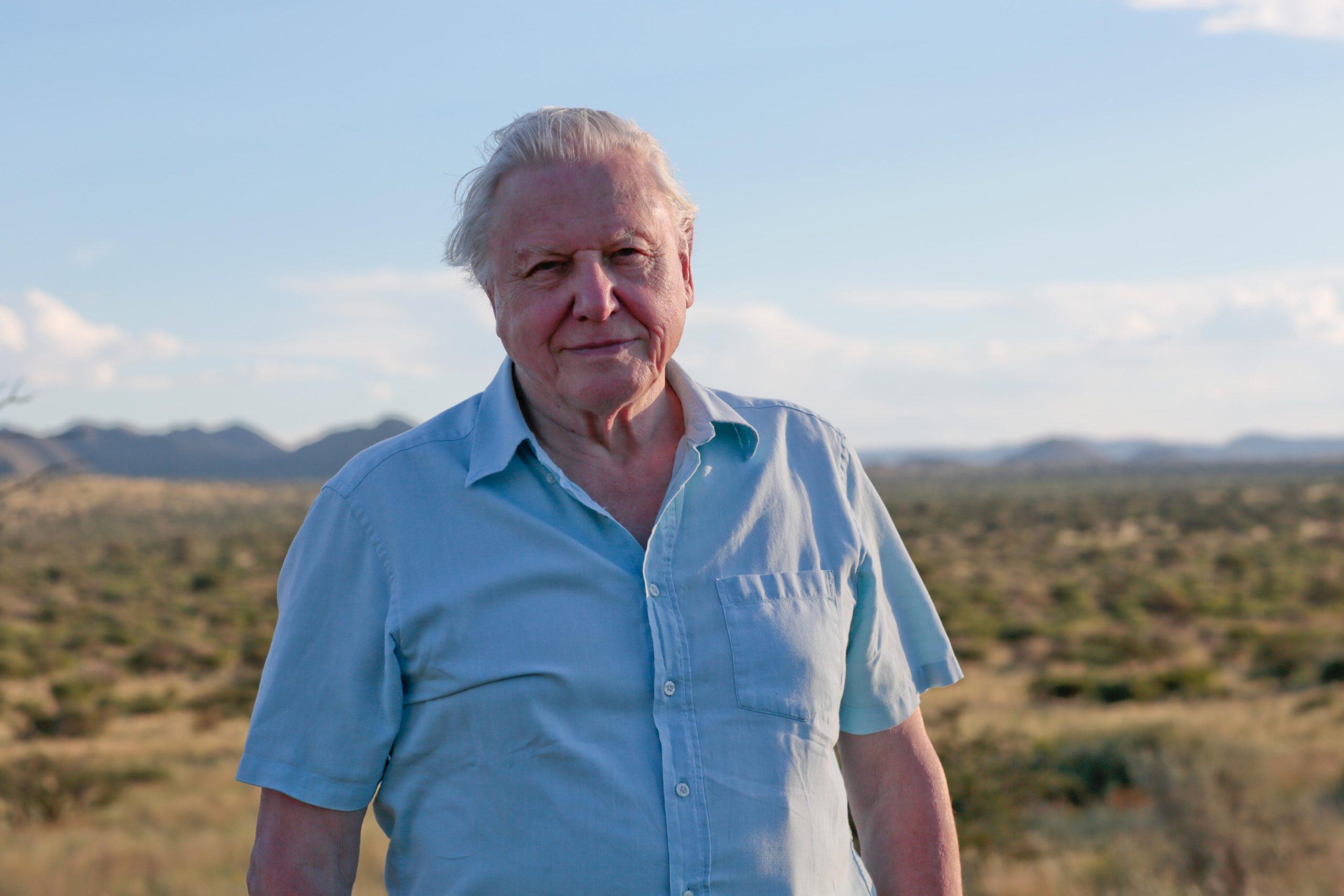
Attenborough’s work is what initially sparked Broad’s interest in science. “I grew up watching ‘Life on Earth’ and ‘Living Planet’ and reading his books, and it’s thanks to David Attenborough that I sort of knew what a taxonomist was,” he said.
“With Sir David’s 100th birthday coming up, I thought this was a great opportunity to name a genus after him. It’s a bit of a mouthful, Attenboroughnculus, but I hope he doesn’t mind too much.”
In response to the news of the newly named wasp, Attenborough sent Broad a handwritten thank-you note. The naturalist already has more than 50 species named after him, including fish, spiders, birds, lizards, beetles, snails, as well as many types of plants and wasps.
In most cases, the species name just references Attenborough’s surname, like in Zaglossus attenboroughi, a type of endangered echidna found in New Guinea.
However, sometimes the tribute is more obscure, such as the case of Syracosphaera azureaplaneta, a type of oceanic phytoplankton the species name of which is a latinization of “The Blue Planet,” a landmark documentary about marine ecosystems that Attenborough narrated in 2001.