Creative Economy Bill 2026: How proposed law could change Kenya’s film and digital media sector
By Dan Kauna, August 24, 2026Kenyan creatives could soon operate under a new legal framework following the introduction of the Creative Economy Bill, 2026.
Sponsored by Webuye West MP Daniel Wanyama and published in Kenya Gazette Supplement No. 190 on August 3, 2026, the Bill proposes setting up two main state agencies to split promotional work from regulatory oversight across the local film, audio-visual, and digital media space.
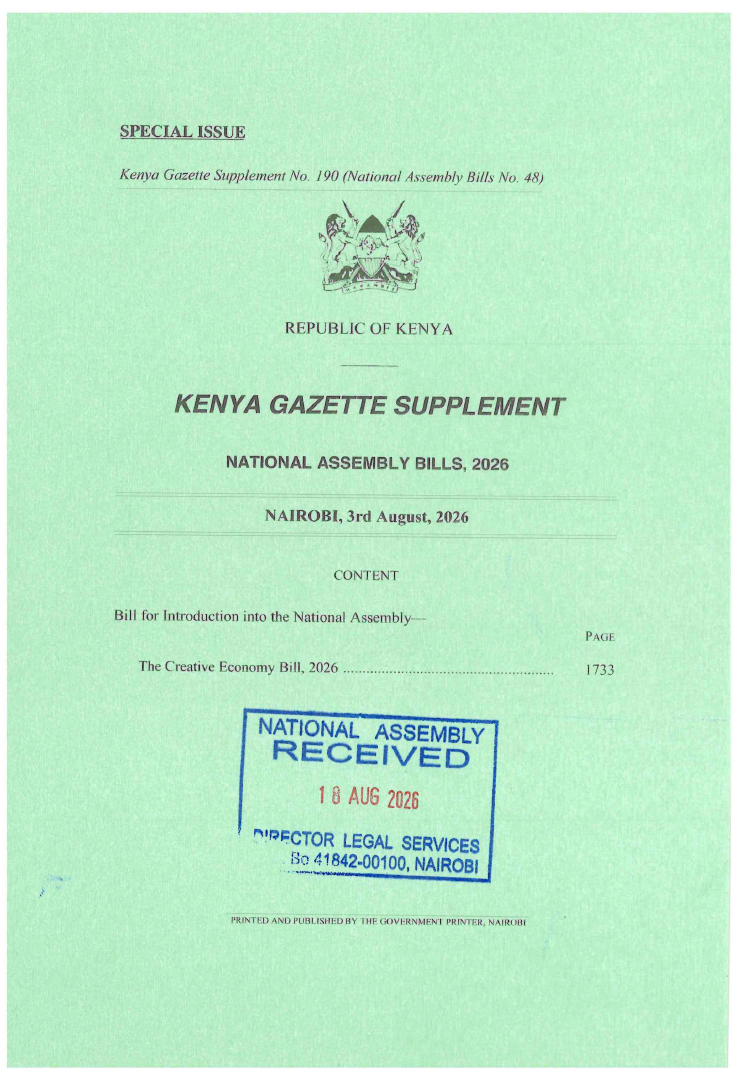
If passed into law, the proposed legislation will repeal the Films and Stage Plays Act and replace existing bodies like the Kenya Film Commission and the Kenya Film Classification Board.
Splitting promotion and regulation
Under the new setup, promotion and commercial growth will sit with a single dedicated body.
Clause 7(1) establishes the Kenya Audio-Visual and Cinema Commission. Clause 8 mandates this commission to “develop, promote and market the audio-visual and cinema industry locally and internationally,” while also building an official archive for Kenyan cinematic works.

Regulatory duties will fall under a separate state authority. Clause 21(1) establishes the Kenya Audio-Visual Regulatory Authority.
This regulator will oversee the creation, exhibition, and broadcasting of content. Under Clause 23, it will issue licences for production, distribution, and “streaming and online platform operations within Kenya.”
The authority will also classify content based on “age suitability”, “cultural considerations” and “public interest.”
Entities that fail to comply face administrative penalties under Clause 24, including “monetary fines”, orders for “closure of non-compliant entities,” and “take-down orders where audio-visual works are prohibited or unclassified under the Act.”
Training, registration, and sector support
The Bill also addresses skill development and artist registration. Clause 35(1) establishes the Kenya School of Film and Creative Arts to offer “technical, vocational, professional and specialised training, mentorship and talent development programmes in film and creative arts.”

To streamline government support, Clause 36 directs that the Cabinet Secretary “shall keep and maintain a register of creatives, creatives’ groups and associations.”
Clause 37 further requires the Cabinet Secretary to “develop incentives programmes and award schemes for the creative economy sector,” including a voucher system to assist artists with equipment, training, and marketing.
Clause 4 guides the proposed law through key principles, emphasising “creativity, innovation and cultural expression as the foundation of creative economy” alongside “inclusivity and equitable participation of all persons in the creative economy, including youth, women and persons with disabilities.”
The Bill remains a proposal and will undergo public participation and parliamentary debate before becoming law.