Advertisement
Professor Hamo questions why supporting African parents is labelled ‘black tax’
15th September, 2026 06:23 PM

Professor Hamo has questioned the use of the term ‘black tax’ when Africans support their parents financially.
He compared the way family support is described among different communities, arguing that similar acts are given different names.
Hamo said some communities are praised for supporting and living with their parents, while Africans can be criticised for doing something similar. He made the comparison while questioning the idea of calling money sent to African parents every month a burden.
“When Indians live with their parents and help them, it’s called generational wealth,” Professor Hamo said on Tuesday, September 15, 2026.
He went on to compare this with how Arabs are viewed when they live together with members of their family. Hamo said such family arrangements are seen positively rather than being described as a financial burden.
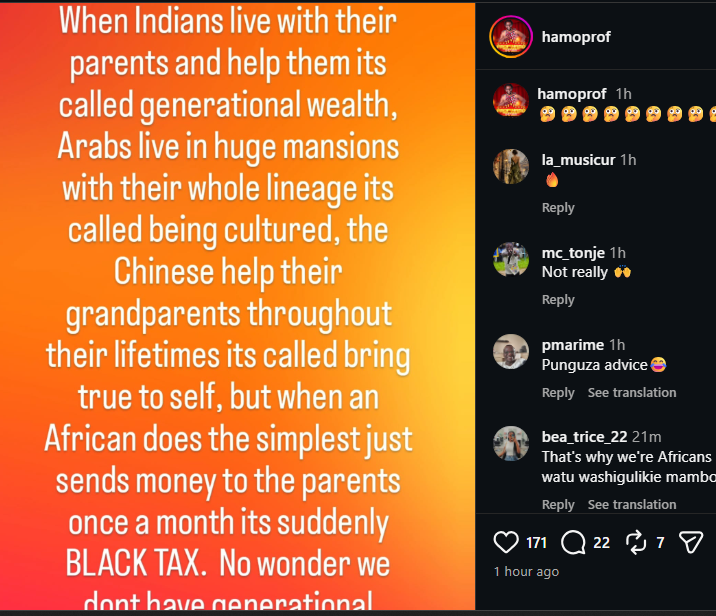
“Arabs live in huge mansions with their whole lineage; it’s called being cultured,” Professor Hamo said.
Hamo questions the ‘black tax’ label
The comedian also brought up the way Chinese families support their older relatives. He said helping grandparents throughout their lives is described in positive terms and linked to staying true to one’s identity.
“The Chinese help their grandparents throughout their lifetimes; it’s called being true to self,” Professor Hamo said.
Hamo then contrasted those examples with the situation of Africans who send money to their parents. He said even a simple monthly contribution can quickly be labelled as ‘black tax’, which he questioned.

“But when an African does the simplest just sends money to the parents once a month it’s suddenly BLACK TAX,” Professor Hamo said.
The comedian questioned the impact of using the term when discussing Africans supporting their parents. He suggested that the label could affect how such family support is viewed and how people think about building wealth across generations.
Hamo said supporting parents should not automatically be seen as a financial burden simply because the people involved are African. He compared the different descriptions given to similar family practices and questioned the difference in how they are viewed.
He also linked the discussion to the issue of generational wealth in Africa. Hamo suggested that the way Africans view support for their parents could be connected to the limited generational wealth he believes exists on the continent.
“No wonder we don’t have generational anything in Africa,” Professor Hamo said.