Mosiria announces new parking rules that could see vehicles clamped and impounded in Nairobi
By Steve Ireri, September 30, 2026Nairobi County Chief Officer for Customer Engagement and Citizen Service Geoffrey Mosiria has unveiled fresh parking rules that could see motorists have their vehicles clamped and impounded as he pushes for greater order in the capital.
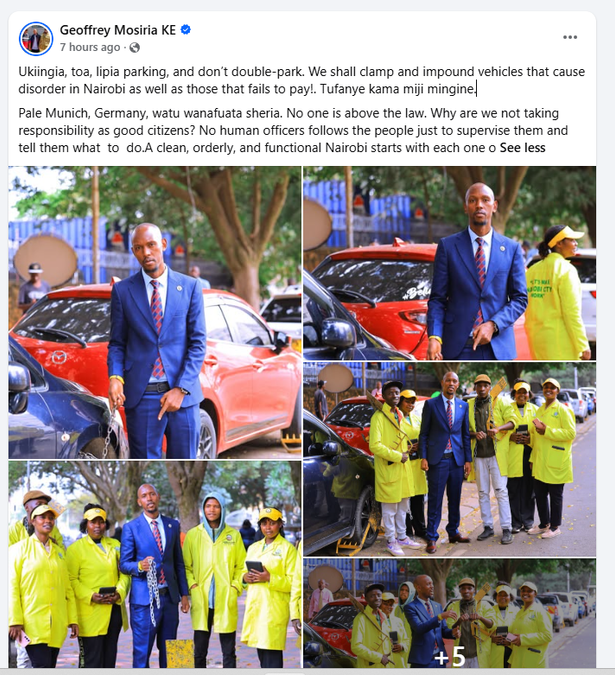
In a Facebook post on Wednesday, September 30, 2026, Mosiria called on Nairobi motorists to pay for parking, avoid double parking and follow the city’s regulations, saying vehicles causing disorder or failing to pay could face enforcement action.
“When you enter, pay for parking, and do not double-park. We shall clamp and impound vehicles that cause disorder in Nairobi as well as those that fail to pay. Let us do things like other cities,” he wrote.
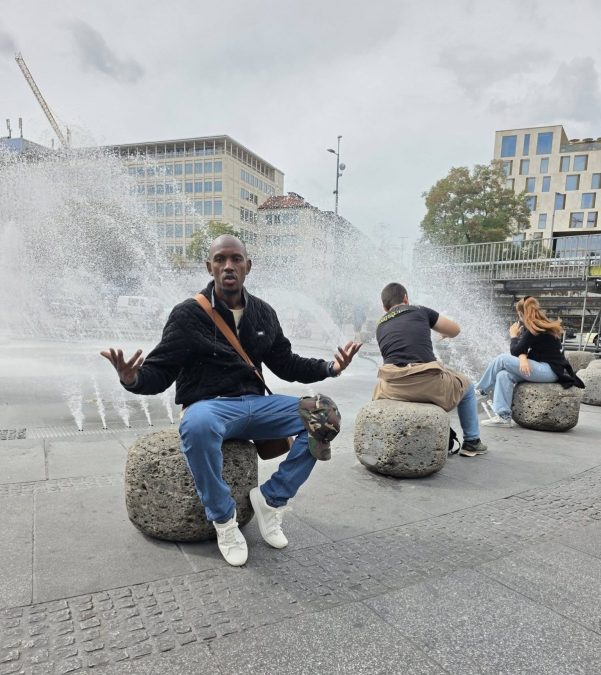
Mosiria has also drawn lessons from Germany, where he said motorists and residents follow established rules without requiring constant supervision from human officers.
“In Munich, Germany, people follow the rules. No one is above the law. Why are we not taking responsibility as good citizens?” he asked.
The Nairobi county official further contrasted the situation with what he observed in Munich, arguing that orderly cities should not depend entirely on officers being physically present to direct members of the public.
“No human officer follows people around just to supervise them and tell them what to do,” Mosiria said.
Mosiria has also urged Nairobi residents to take personal responsibility for keeping the capital clean, orderly and functional, saying the transformation of the city should begin with individual citizens.
“A clean, orderly, and functional Nairobi starts with each one of us,” he added.
Return from Germany
Mosiria’s new directives on parking come only days after he returned from Germany, where he said he picked up lessons on discipline, traffic management and public order that he hoped Nairobi residents would embrace.
Mosiria said the trip had also involved efforts to seek investors who could help Nairobi develop software for public participation and customer service, but added that it also allowed him to observe how residents interacted with their city.
“I had gone to Germany to learn, and we were also seeking investors who can help us with software for public participation and customer service,” Mosiria said.
One of the key lessons he highlighted was the apparent willingness of residents to follow traffic rules without requiring constant supervision from enforcement officers.
“While there, I learnt many things, including the fact that people there follow rules. They obey, and you do not have to deploy officers,” he said.
Mosiria specifically pointed to motorists, saying they generally remained on the correct side of the road and avoided practices such as overlapping, while pedestrians observed traffic lights at zebra crossings.
“Cars do not drive on wrong sides or overlap. On zebra crossings, people obey traffic lights,” he said.
He also raised concerns about pedestrians in Nairobi crossing roads instead of using designated footbridges, saying he had received reports of the practice after returning from Germany.
“Kenyans, I have returned home. I had gone abroad a bit. I am back home and I hear many things have happened. People were not using footbridges when I was away; they were crossing on the roads and I heard there were many cases,” Mosiria said.