Willis Otieno: Securitising fuel levy undermines law and public accountability
By Mustafa Juma, July 17, 2025Lawyer Willis Otieno has raised alarm over the government’s move to securitise the fuel levy.
Taking to his official X account on Wednesday, July 16, 2025, Otieno warned that the move is not only legally questionable but also undermines the spirit of transparency and accountability enshrined in Kenya’s Constitution.
Otieno was responding to remarks by Treasury Cabinet Secretary John Mbadi, who has supported the idea of leveraging future fuel levy collections as collateral to raise funds for infrastructure projects, after Kiharu MP Ndindi Nyoro raised concerns over the recent increase in fuel prices.
In a strongly worded statement, Otieno reminded leaders that the Fuel Levy is a dedicated charge under the Roads Maintenance Levy Fund (RMLF), governed by the Kenya Roads Board Act and the Public Finance Management Act.
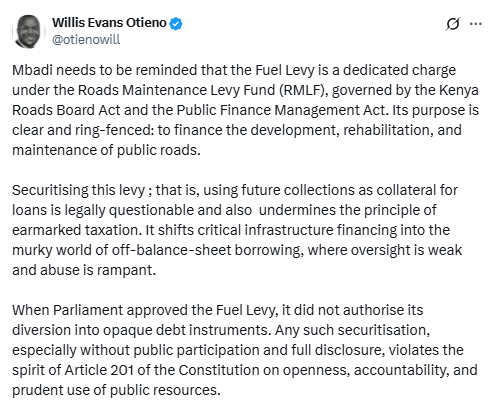
“Mbadi needs to be reminded that the Fuel Levy is a dedicated charge under the Roads Maintenance Levy Fund (RMLF), governed by the Kenya Roads Board Act and the Public Finance Management Act. Its purpose is clear and ring-fenced: to finance the development, rehabilitation, and maintenance of public roads,” the lawyer stated.
Abuse
According to Otieno, securitising the levy—that is, borrowing against future revenues—amounts to diverting earmarked funds into off-balance-sheet arrangements, which are often opaque and prone to abuse.
“Securitising this levy—that is, using future collections as collateral for loans—is legally questionable and also undermines the principle of earmarked taxation. It shifts critical infrastructure financing into the murky world of off-balance-sheet borrowing, where oversight is weak and abuse is rampant,” he stated.
He further noted that when Parliament approved the Fuel Levy, it did not authorise its use as collateral for loans.
“When Parliament approved the Fuel Levy, it did not authorise its diversion into opaque debt instruments. Any such securitisation, especially without public participation and full disclosure, violates the spirit of Article 201 of the Constitution on openness, accountability, and prudent use of public resources,” Otieno wrote on X.
Ndindi Nyoro’s concerns
Ndindi Nyoro had claimed that domestic policy inefficiencies are behind the recent fuel price hike.
He urged the government to re-evaluate taxation policies and streamline the supply chain to ease pressure at the pump.
“We must address the root causes locally. Kenyans are paying the price for inefficiencies that can be corrected,” Nyoro stated.
“Global oil prices peaked last year, not this year. It is clear that the government is using false narratives to justify high pump prices.”
Nyoro pointed to domestic taxation as the real culprit behind the soaring costs, saying more than Ksh80 per litre of petrol and Ksh76 for other fuels are swallowed by taxes and levies.
He further revealed that in 2023, the government quietly introduced a Ksh7 per litre levy at a time when global oil prices were dropping, denying Kenyans the benefits of falling international rates.