Self-employed Kenyans top list of bribe givers in new report
By Nancy Marende, July 31, 2025Self-employed Kenyans have emerged as the leading givers of bribes, according to a new report by Transparency International Kenya that sheds light on the extent of corruption in everyday public service interactions.
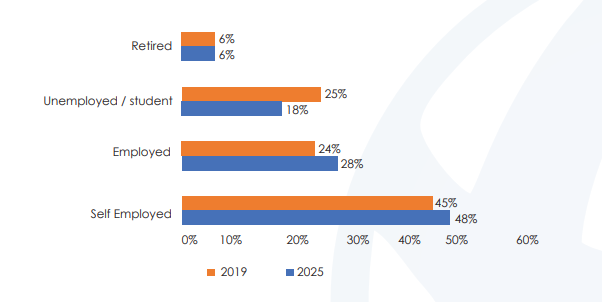
In its latest Kenya Bribery Index, dated July 17, 2025, the report reveals that 48% of individuals in the self-employed category admitted to paying bribes, the highest among all occupational groups surveyed.
The category was followed by the employed at 28 percent, the non-employed/student at 18 percent, and the retired at 6 per cent.
“The self-employed category registered the highest frequency of bribe paying at 48 percent. This ranking tallies with the previous survey in 2019, where the same category topped, albeit with a slightly lower magnitude of 45 percent,” read the report.
The report attributed this trend to the frequent interaction that self-employed individuals have with services prone to corruption, such as business licensing, regulatory compliance, and law enforcement.
/X
It revealed that these interactions often expose them to more opportunities for bribery, either through coercion or to expedite service delivery.
“The frequency of interaction of these categories with public services is much lower, and so is the level of vulnerability to bribe demands.”
In its latest Kenya Bribery Index, dated July 17, 2025, the organisation found that 64 percent of male respondents reported paying a bribe compared to 36 per cent of women. The survey, which captured data from 15 counties, documented both the frequency of bribe payments and the socio-economic factors that shape interactions with public institutions.
“Across the gender divide, the proportion of male respondents who reported paying for a bribe was much higher at 64% compared to 36% among females,” the report notes.
TI Kenya attributed the disparity to traditional gender roles, which often place men at the centre of economic activities, thus increasing their exposure to corruption-prone spaces such as licensing offices, police stations, and land registries.
“It could be likely that due to gender norms and relations, men are more active economically and therefore likely to interact more with public institutions, eliciting more bribery opportunities,” the report explained.