KeNHA warns of traffic delays as survey begins for Nairobi–Mau Summit expressway
By Martin Oduor, July 9, 2025The Kenya National Highways Authority (KeNHA) has announced a 10-day traffic data collection exercise on two of the country’s busiest transport corridors — a move seen as part of the broader groundwork for the proposed Nairobi–Nakuru–Mau Summit expressway project, a major public-private infrastructure initiative aimed at modernising the country’s key road network.
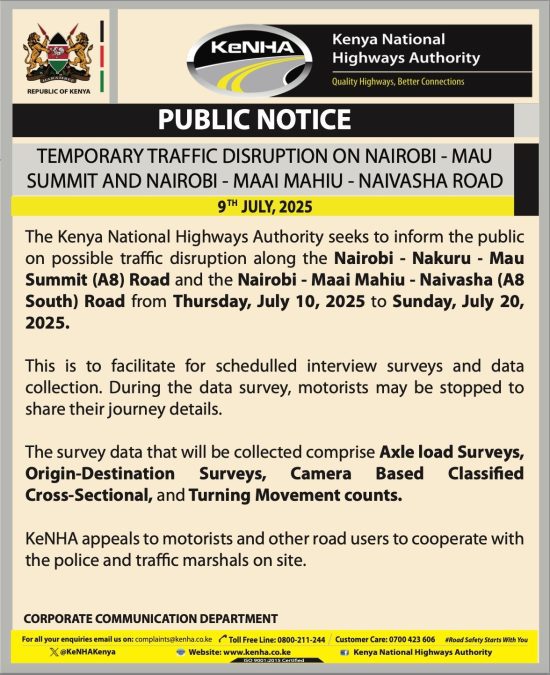
In a public notice issued on Wednesday, July 9, 2025, KeNHA said that motorists using the Nairobi–Nakuru–Mau Summit Road (A8) and the Nairobi–Maai Mahiu–Naivasha Road (A8 South) should expect temporary traffic disruptions between Thursday, July 10 and Sunday, July 20, 2025.
The authority stated that the disruptions will allow for scheduled interview surveys and data collection, including origin-destination interviews, camera-based traffic counts, turning movement analyses, and axle load surveys.
“During the data survey, motorists may be stopped to share their journey details,” the notice reads.
“KeNHA appeals to motorists and other road users to cooperate with the police and traffic marshals on site.”
The traffic surveys are expected to provide critical insights into travel patterns and vehicle types — information that will feed into transport planning and infrastructure development decisions along the two high-volume corridors.
A road to the future
The Nairobi–Nakuru–Mau Summit highway is at the heart of a public-private partnership (PPP) infrastructure initiative signed in 2021, but whose implementation has been slow due to financial and contractual delays.
The project, once underway, is expected to convert the current 175-kilometre road into a dual carriageway, significantly easing traffic congestion and improving travel safety between Nairobi and the Rift Valley.
Stretching from the capital through Limuru, Naivasha, Gilgil, Nakuru, and onwards to Mau Summit, the corridor forms a vital section of the Northern Corridor, linking Nairobi to Uganda, Rwanda, and eastern Democratic Republic of Congo.
It carries both passenger and freight traffic and is considered one of the country’s most economically significant roadways.
The new highway, estimated at over Ksh180 billion, will be Kenya’s most ambitious road project under a PPP model.
Local concerns and logistics
While KeNHA’s notice focuses on the short-term inconvenience for motorists, the larger vision underscores the government’s push to modernise national transport infrastructure.
However, critics have raised concerns over tolling, potential displacement of communities, and the long-term affordability of such mega-projects for ordinary Kenyans.
Still, KeNHA insists the benefits, including shorter travel times, reduced vehicle wear and tear, and increased regional trade, will outweigh the costs.
The current data collection is expected to support both environmental impact assessments and future engineering decisions.
The survey also includes the Maai Mahiu–Naivasha stretch, a critical connector between the Southern Bypass and inland container depots and industrial zones in Naivasha.
This area has grown in strategic importance following the expansion of Kenya’s Standard Gauge Railway (SGR) and inland dry port facilities, positioning it as a logistics hub for East Africa.
As the country positions itself as a regional transport and trade leader, this traffic data exercise signals not just an administrative process but a crucial preparatory step toward transforming how the country moves — and how its roads serve an expanding, interconnected economy.
KeNHA has asked motorists to remain patient and cooperative during the 10-day survey, promising minimal disruption and maximum transparency as the country navigates the next phase of its transport evolution.