IGAD urges stronger bilateral labour agreements to safeguard workers’ rights
By Nancy Marende, October 22, 2025The Intergovernmental Authority on Development (IGAD) has called on member states to move beyond studies and assessments and take concrete action to strengthen labour migration governance across the region.
According to IGAD Executive Secretary Workneh Gebeyehu, sufficient information already exists to inform meaningful reforms in labour migration governance.
Also watch: Call to protect Kenyan migrant workers in Gulf
Speaking during the Experts Meeting of the 3rd IGAD Ministerial Conference on Labour, Employment, and Labour Migration in Nairobi on Wednesday, October 22, 2025, Gebeyehu urged governments to implement functioning bilateral labour agreements that regulate the movement of workers and safeguard their rights and welfare.
“On labour migration governance, the time for baseline assessments has passed. We have done enough and have the information in our hands. We need functioning bilateral labour agreements that protect workers’ rights, not just manage flows,” he stated.
Furthermore, he emphasised the importance of portable social protection systems, enabling migrant workers to access essential services across borders.
“We need portable social protection so a worker from Somalia can access healthcare in Saudi Arabia. We need regional coordination on fair recruitment that eliminates exploitative fees,” he added.
CS Alfred Mutua
On his part, Foreign and Diaspora Affairs Cabinet Secretary Alfred Mutua outlined the government’s comprehensive initiatives aimed at ensuring the safety, welfare, and empowerment of Kenyans working abroad.
“Kenya has enhanced the protection of migrant workers through developing a Migrant Workers Welfare Fund to provide emergency support and facilitate repatriation of distressed workers abroad,” Dr. Mutua said.
Also watch: Government dismisses setback claims, hails success of youth labour export programme
He further noted that the government has strengthened the registration and regulation of private recruitment agencies under the National Employment Authority (NEA), a move designed to curb exploitation and ensure ethical recruitment standards.
In addition, he revealed that the country has focused on capacity building for labour attachés and the establishment of Labour Desks at Jomo Kenyatta International Airport (JKIA) and Moi International Airport, to provide information and assistance to departing and returning migrant workers.
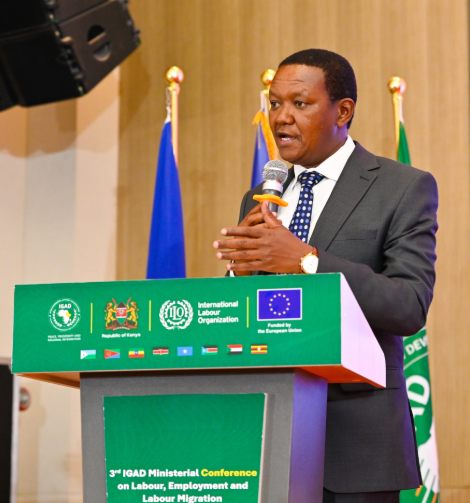
“To enhance institutional coordination and data sharing, we have established an Inter-Agency Technical Committee on Labour Migration. We are collaborating with IGAD, ILO, and the African Union to strengthen institutional capacity and information management.”
He emphasised that continuous training is being provided to labour officers, inspectors, and labour attachés to improve governance efficiency and service delivery, reaffirming Kenya’s commitment to protecting the rights and welfare of its migrant workforce.
The two-day technical session brought together senior experts from IGAD member states to shape policy recommendations on labour mobility, employment policies, and migration governance ahead of the ministerial deliberations.
Participants included representatives from Ministries of Labour and Employment, Interior, Immigration, and Foreign Affairs, as well as Social Partners comprising employer federations and trade union organisations from across the IGAD region.