Advertisement
Govt issues report on Kenyan mothers, undocumented children in Saudi Arabia
15th November, 2025 01:09 PM

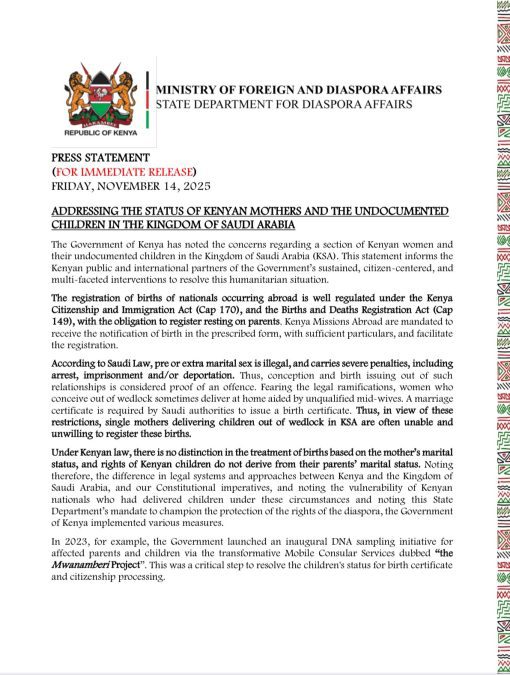
The Ministry of Foreign Affairs, through the Principal Secretary, State Department for Diaspora Affairs, Roseline Kathure Njogu, has issued a report on Kenyan mothers and undocumented children in the Kingdom of Saudi Arabia.
In a press statement released on Friday, November 14, 2025, the PS announced that the government has noted the concerns regarding a section of Kenyan women and their undocumented children in the Kingdom of Saudi Arabia.
Also watch: Kiambu Senator demands answers over DNA rules trapping Kenyan mothers in Saudi Arabia
PS Njogu acknowledged the Kenyan public and international partners of the government’s sustained, citizen-centred, and multi-faceted interventions to resolve this humanitarian situation.
“The registration of births of nationals occurring abroad is well regulated under the Kenya Citizenship and Immigration Act (Cap 170) and the Births and Deaths Registration Act (Cap 149), with the obligation to register resting on parents. Kenya Missions Abroad are mandated to receive the notification of birth in the prescribed form, with sufficient particulars, and facilitate the registration,” PS Njogu said.
Saudi marital law
She went on explaining that according to Saudi Law, pre- or extramarital sex is illegal and carries severe penalties, including arrest, imprisonment, and/or deportation. Thus, conception and birth issuing out of such relationships are considered proof of an offence.
“Fearing the legal ramifications, women who conceive out of wedlock sometimes deliver at home, aided by unqualified midwives. A marriage certificate is required by Saudi authorities to issue a birth certificate. Thus, in view of these restrictions, single mothers delivering children out of wedlock in Saudi Arabia are often unable and unwilling to register these births,” she explained.
PS Njogu further explained that, contrary to Saudi Arabian laws, in Kenya, there is no distinction in the treatment of births based on the mother’s marital status, and the rights of Kenyan children do not derive from their parents’ marital status.
“Under Kenyan law, there is no distinction in the treatment of births based on the mother’s marital status, and rights of Kenyan children do not derive from their parents’ marital status,” she said.
Also watch: Koruruma family appeals for help to bring home daughter’s body from Saudi Arabia
“Noting, therefore, the difference in legal systems and approaches between Kenya and the Kingdom of Saudi Arabia, and our constitutional imperatives, and noting the vulnerability of Kenyan nationals who had delivered children under these circumstances, and noting this State Department’s mandate to champion the protection of the rights of the diaspora, the Government of Kenya implemented various measures,” she explained.
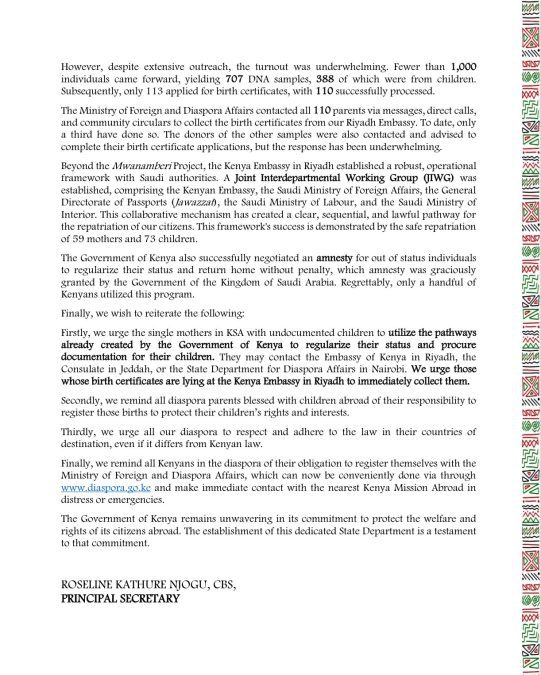
The PS explained how, in 2023, the government launched an inaugural DNA sampling initiative for affected parents and children via the transformative Mobile Consular Services dubbed “the Mwanamberi Project,” as it was a critical step to resolve the children’s status for birth certificates and citizenship processing.