Advertisement
Finger pointed at principals: 29.5% of Kenyans say teachers fuel exam cheating
01st December, 2025 12:19 PM

A new national survey has cast a harsh spotlight on the country’s school system, revealing that many Kenyans believe exam malpractice is being driven from within the institutions meant to uphold academic integrity.
The Stahili Pulse Report, released on December 1, 2025, surveyed 3,222 randomly selected adults across all 47 counties.
The survey findings were released just weeks after millions of students completed the Kenya Certificate of Secondary Education (KCSE), the Kenya Primary School Education Assessment (KPSEA), and several other national examinations — a period often marked by heightened scrutiny over exam security.
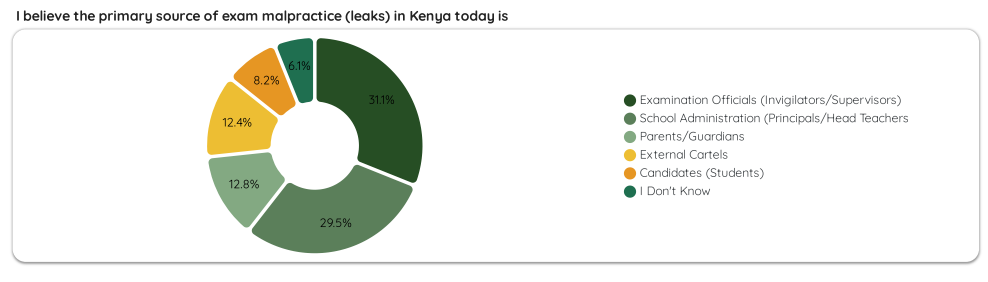
According to the findings, 31.1 per cent of respondents believe examination officials, invigilators and supervisors, are principally responsible for exam malpractice.
A close second, 29.5 per cent blame school administrators, including principals and head teachers, reflecting widespread concern that the pressure to post strong academic results may be encouraging institutional-level cheating.
The report further shows that 12.8 per cent of Kenyans believe parents or guardians play a role in facilitating exam cheating, while 12.4 per cent point to external cartels that have long been suspected of leaking papers to schools and candidates.
Interestingly, only 8.2 per cent of respondents faulted students themselves, suggesting that the public views learners more as victims of a compromised system than active perpetrators.
Another 6.1 per cent said they did not know who was responsible for exam leaks, underscoring the opacity that often surrounds these scandals.
The survey comes at a time when the integrity of national assessments is under renewed national debate.
As education reforms continue to unfold, the findings are likely to intensify calls for deeper structural accountability within schools and examination bodies.
Stahili Pulse Report
Get Kenya’s Real Pulse – Every Week with Stahili.
Make faster, smarter business decisions with Stahili Pulse Reports. Live access, real-time, trended insights across 75 sectors and products gathered daily from over 40,000 consumers across Kenya.
Stay informed on brand health, consumer preference and sector trends, all from verified Kenyan voices on the Stahili App.
Get the latest Stahili Pulse Report and unlock the data behind Kenya’s rapidly changing consumer market.
Want to know more and get your Market Pulse access?
Email [email protected] and we’ll get your finger on the pulse.