Why Kasarani will host 2029 World Athletics Championships and not Talanta Stadium
By Joel Masibo, September 15, 2026Kenya has achieved a historic breakthrough after Nairobi was awarded the 2029 World Athletics Championships, becoming the first African city to stage the global track and field showpiece. World Athletics made the announcement on Tuesday, September 15, 2026, with Nairobi beating bids from London and Rome, while Munich was selected for 2031.
While Nairobi has two major modern stadium projects, Moi International Sports Centre and the new Talanta Sports City, there is a strong case for Kasarani to remain the principal venue for the championships.
In fact, the history, design and existing athletics infrastructure at Kasarani make it a considerably more logical choice than Talanta.
Kasarani was built for athletics
Kasarani is not simply a football stadium that happens to have an athletics track. Athletics has been embedded in the identity of the facility since it was built for the 1987 All-Africa Games during the late President Daniel Toroitich Arap Moi’s regime.
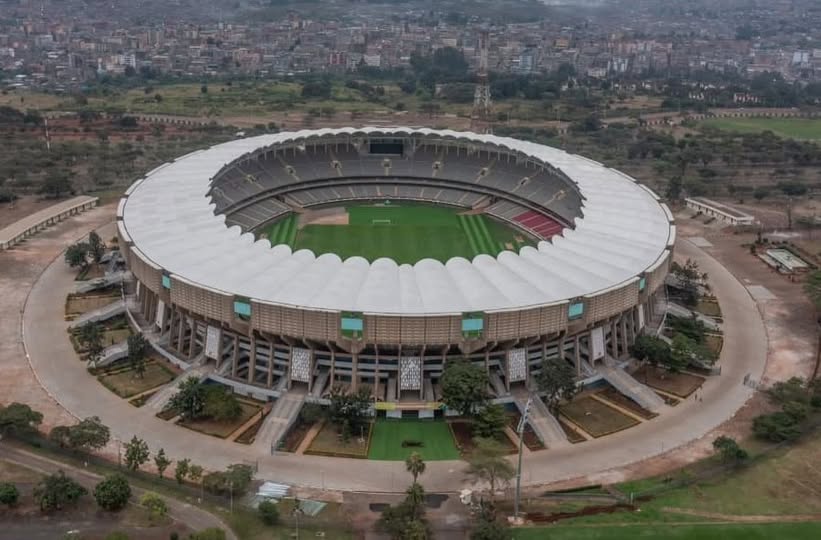
Its athletics infrastructure has already been used for major international competitions, including the 2017 World U18 Championships and the 2021 World U20 Championships. World Athletics’ own venue information for the 2021 championships lists Kasarani as the main stadium and highlights its extensive competition infrastructure.
The stadium has previously been configured with a 400-metre, eight-lane Mondo track, together with facilities for the full range of track and field events.
The documented facilities have included:
Two high-jump sites
Two pole-vault sites
Two long/triple-jump sites
Four shot-put sites
A discus/hammer facility
Two javelin facilities
A steeplechase water jump
A dedicated warm-up and training area
That is important because a World Athletics Championships is far more demanding than simply having a running track around a football pitch. The venue must accommodate sprinting, middle- and long-distance races, hurdles, steeplechase, jumps, throws and combined events within an integrated competition environment.
Kasarani already has the DNA of such a facility.
The new track strengthens Kasarani’s case
There was a period when the state of Kasarani’s track raised legitimate questions about whether the stadium could continue hosting elite international athletics.
The track installed for the 2017 World U18 Championships had deteriorated, with the government confirming in 2025 that it needed replacement. That weakness has since been addressed as the facility is currently undergoing a major facelift ahead of the 2027 Africa Cup of Nations.
The stadium now has a new Mondo surface, with meet organisers saying a World Athletics surveyor was brought in to ensure the facility met the required standards. The new track was one of the reasons organisers were confident about hosting the 2026 Kip Keino Classic.
That upgrade effectively removes one of the biggest arguments that could have been made against Kasarani.
Sports Kenya also describes Kasarani’s running track as suitable for local and international athletics meets.
Kasarani has already passed the international-events test
Another advantage is experience.
Kasarani does not need to prove that it can host a major athletics championship from scratch. It has already done so.
The 2017 World U18 Championships and 2021 World U20 Championships gave Kenya experience in athlete accommodation, competition management, media operations, accreditation, training venues, technical officials and field-event logistics.
World Athletics’ inspection team also visited Kasarani and Nyayo in May 2026 as part of the country’s 2029 bid preparations. The inspection specifically examined areas including the athletics tracks, grandstands and planned infrastructure upgrades. That history matters.
For an event involving athletes from roughly 200 countries, the safest option is usually not the newest stadium, but the venue that combines modern infrastructure with a demonstrated ability to stage international athletics.
Talanta was designed with a different purpose
This is where the comparison with Talanta becomes particularly significant.
The 60,000-capacity Talanta Sports City is arguably the more spectacular new stadium. It is being developed as a flagship venue for football and rugby and is expected to play a major role in Kenya’s hosting of the 2027 Africa Cup of Nations.
But its greatest strength is also its limitation for the World Athletics Championships.
Talanta does not have an athletics track.
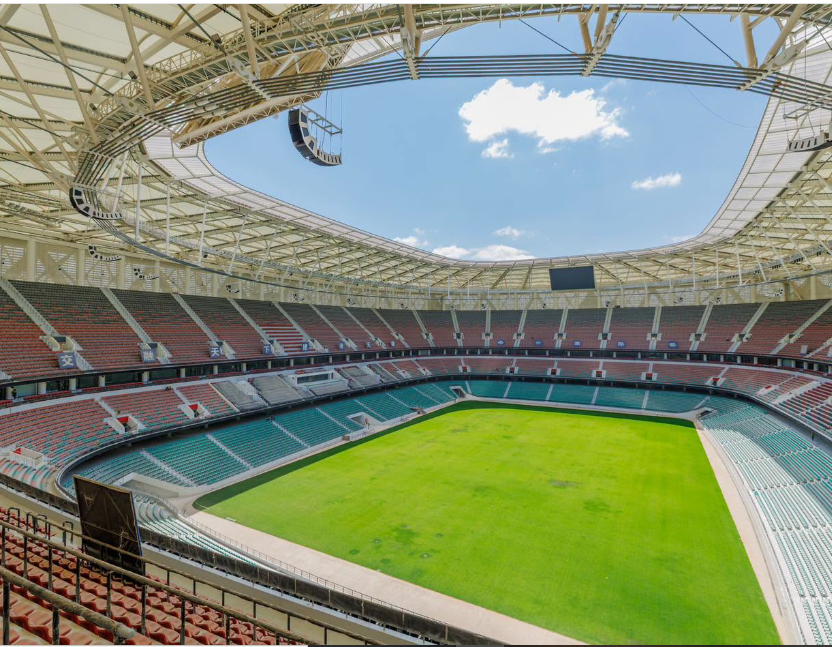
The stadium’s design places spectators much closer to the football pitch, a feature that is attractive for football and rugby. Reports on the project have consistently indicated that the stadium was designed without a conventional athletics track.
That makes Talanta an excellent football stadium, but not the obvious venue for a championship whose central product is athletics.
Adding a track around Talanta would also fundamentally alter the character and configuration of the stadium. It would defeat one of the design’s principal advantages: keeping spectators close to the playing surface.
Bigger capacity does not automatically make Talanta better
Talanta’s planned 60,000 seats compared with Kasarani’s current capacity of about 48,000 could initially make the newer stadium appear to be the obvious choice.
But capacity alone does not determine the suitability of a World Athletics Championships venue.
The competition requires a certified athletics track, field-event areas, athlete warm-up facilities, call rooms, technical areas, media facilities and other specialised infrastructure.
Kasarani already has the basic architecture required for those functions.
Talanta would have to be adapted for a purpose for which it was not primarily designed.
That would make little practical sense when Nairobi already possesses a stadium with decades of athletics experience.
Kasarani also fits Kenya’s athletics identity
There is a symbolic argument as well.
Kasarani has been one of the most important homes of Kenyan athletics for decades. It has hosted national trials, international meetings and world-level championships.
The stadium is also the established home of the Kip Keino Classic, a World Athletics Continental Tour Gold meeting. The facility’s new Mondo track has already been tested by elite athletes in international competition.
This gives Kasarani something Talanta cannot buy simply by being new: athletics heritage.
And that could be particularly important for the 2029 championships.
World Athletics President Sebastian Coe described Nairobi’s successful bid as compelling and highlighted Kenya’s deep connection with athletics.
It therefore makes sense for the championship to be staged in the stadium that most visibly represents that connection.
Talanta can still have an important role
Choosing Kasarani does not mean Talanta would be irrelevant during the championships.
Its proximity and modern facilities could make it useful for football, cultural events, entertainment, hospitality, training, fan activities or other supporting functions around the championships.
The two facilities could complement each other.
But the main athletics competition venue should remain Kasarani.
In retrospect, Kenya’s bid itself provided perhaps the clearest indication of where the championship was intended to be staged.
When Kenya formally submitted its 2029 bid, Kasarani was identified as the proposed main venue.
And following today’s decision, Reuters has confirmed that the 2029 championships will be held at Kasarani Stadium, which is currently undergoing renovations ahead of AFCON 2027.
So while Talanta may eventually become Kenya’s premier football stadium, Kasarani remains the more logical home of Kenyan athletics.