2029 World Athletics: Why London loss to Nairobi sparked negative coverage in parts of UK media
By William Muthama, September 17, 2026The decision to award Nairobi the 2029 World Athletics Championships has triggered criticism in sections of the British media, with commentators questioning why the Kenyan capital was selected ahead of London.
World Athletics announced Nairobi as the host on Tuesday, September 15, 2026, making it the first African city to stage the global championships.
While Kenya celebrated the historic decision, attention in Britain quickly shifted to London’s failed bid, with some commentators questioning the decision to overlook the English capital.
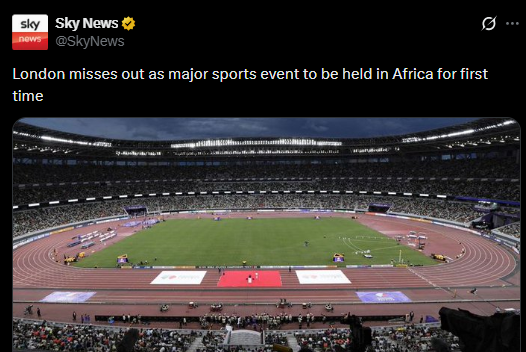
Sky News also sparked reactions in Kenya after a post on X carried the caption, “London misses out as major sports event to be held in Africa for first time.”
The wording foregrounded London’s loss while referring to Africa rather than naming Nairobi, prompting some Kenyans online to question why the Kenyan capital’s historic achievement was not given greater prominence.
There has long been criticism of international coverage that portrays Africa as a single place rather than 54 countries with very different histories and circumstances.
Using “Africa” instead of referring to a particular African country can carry a negative connotation and highlight how some international media outlets may overlook the political, economic and cultural differences between countries such as Kenya, Ghana, Nigeria, Uganda, Tanzania, South Africa etc.
In this context, Munich, Germany, won the right to host the 2031 World Athletics Championships, and international media have generally referred to Munich — and, to a lesser extent, Germany — as the host. They have not framed it as “Europe hosting the 2031 event”, as is the case when an African country is awarded the right to host a major international event.
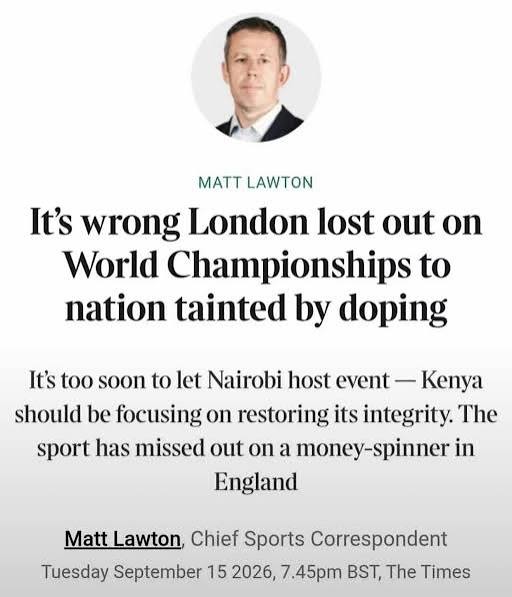
The criticism became sharper after The Times sports correspondent Matt Lawton challenged World Athletics’ decision, particularly over Kenya’s anti-doping record.
“World Athletics have set new standards for sports governance under Seb Coe. But I fundamentally disagree with the decision by the WA Council to hand the 2029 World Championships to Nairobi ahead of London,” Lawton posted on X.
In his Times article, Lawton questioned whether Nairobi should have been selected while Kenya continues to face scrutiny over doping cases involving its athletes.
So, what has fuelled the frustration among some British commentators?
Kenya’s doping concerns
A major point of contention has been Kenya’s anti-doping record.
Since the Athletics Integrity Unit was established in 2017, 318 Kenyan athletes have been sanctioned for anti-doping rule violations, according to The Times.
British critics have argued that awarding the championships to Kenya sends the wrong message at a time when athletics continues to fight doping.
World Athletics, however, has pointed to Kenya’s efforts to strengthen its anti-doping programme, including a reported $5 million annual government investment over five years.
The issue nevertheless drew strong reactions from Kenyans online.
“An odd argument. Nairobi won a competitive international bid assessed by World Athletics. Africa has given the sport some of its greatest athletes, yet has never hosted its World Championships. London losing is not an injustice. It is called global sport,” Gina Din said.
“It’s okay. It’s your opinion. Everyone else has theirs,” Janet Machuka said.
London’s Ksh7.8B investment
Another source of frustration was the scale of London’s bid.
The proposal was backed by £45 million (Ksh7.8 billion), comprising £35 million from the UK Government and £10 million from the Mayor of London’s office.
London also pointed to its experience hosting the 2017 World Championships at the London Stadium, where the event attracted more than 660,000 spectators.

UK Athletics chief executive Jack Buckner expressed disappointment after London lost the bid.
“We are deeply disappointed that the 2029 World Athletics Championships will not be held in London. We believed we had an outstanding bid which would genuinely take the sport to new levels,” Buckner said.
The failed bid therefore represented the loss of a proposal that had significant public funding and was built around London’s previous success in hosting the championships.
Three non-European hosts
The third issue is the geographical sequence of the next three championships.
Tokyo hosted the 2025 edition, Beijing will host the 2027 championships and Nairobi will stage the 2029 event.
Some British commentary has questioned why Europe will go three consecutive editions without hosting the championships.
World Athletics President Sebastian Coe defended the decision, describing Nairobi’s proposal as a “compelling and emotional bid” while stressing that Europe remained a major centre for athletics.
Coe said the decision was also based on factors including government guarantees, budgets and the potential to grow the sport.
For Nairobi, the decision marks a historic first for Africa.
For London, it represents the loss of a heavily funded bid to host the championships again.
The contrasting reactions have since turned the 2029 decision into a wider debate over Kenya’s anti-doping record, London’s failed bid and World Athletics’ push to take its flagship event to new regions.