Advertisement
Arsenal fans storm Nairobi CBD for Premier League’s trophy parade
27th May, 2026 03:08 PM

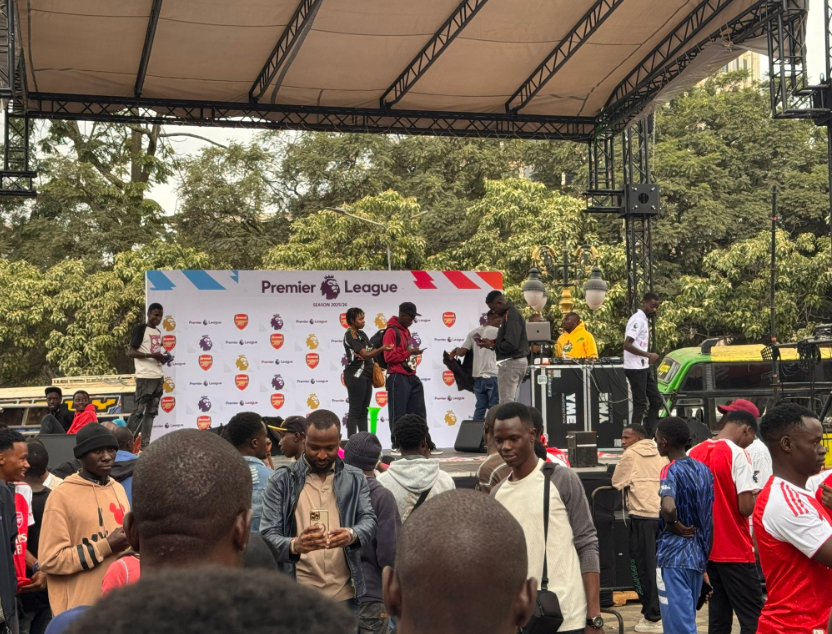
Thousands of Arsenal fans in Kenya thronged Nairobi Central Business District (CBD) for an eagerly-awaited English Premier League trophy parade at the National Archives, bringing normal activities to a halt.
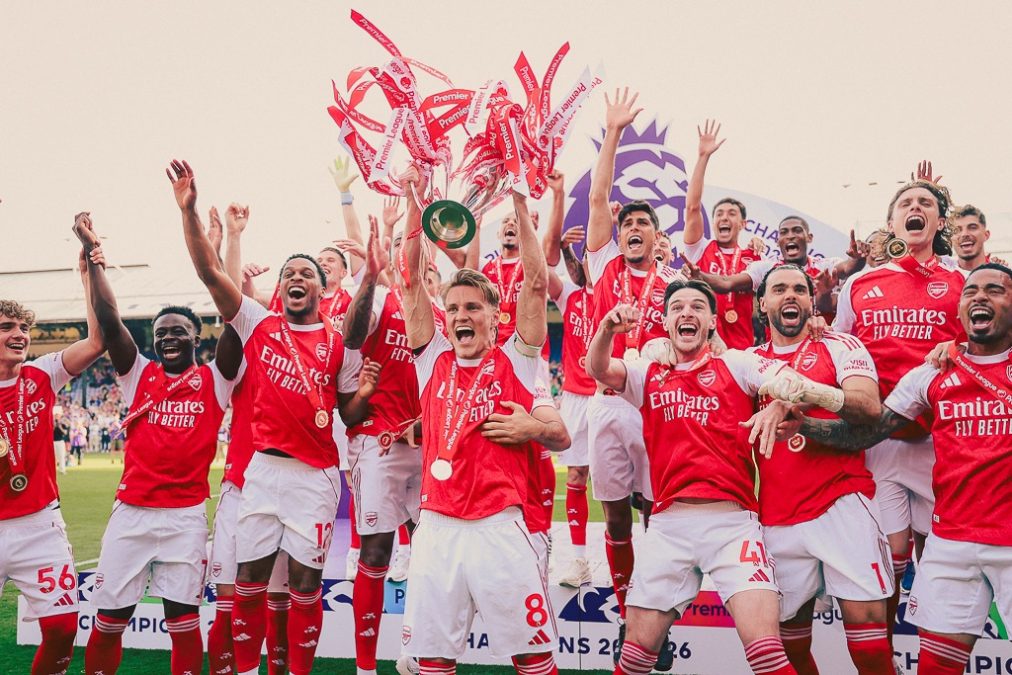
Donning the Gunners’ famous home shirts, the Arsenal faithful painted Moi Avenue red, singing and dancing after Mikel Arteta broke a 22-year-old Premier League title winless jinx at the Emirates recently.
However, it is not clearly established whether the trophy on display was the one lifted by Martin Odegaard at Selhurst Park on Sunday, May 24, 2026 or a replica.
Gidi defends Arsenal’s celebrations
Meanwhile, popular Kenyan radio presenter and outspoken football enthusiast Joe Gidi has defended Arsenal supporters across Africa who took to the streets in celebration following the club’s English Premier League triumph after 22 years, arguing that critics are failing to understand the global nature of modern football fandom.
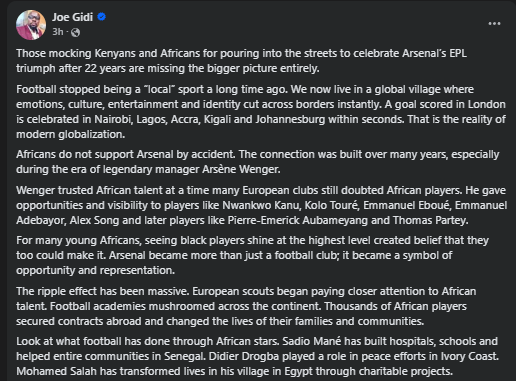
In a statement on Wednesday, May 27, 2026, the celebrated broadcaster said football ceased being a purely local affair many years ago and has evolved into a worldwide cultural phenomenon that transcends borders, race and nationality.
“Those mocking Kenyans and Africans for pouring into the streets to celebrate Arsenal’s EPL triumph after 22 years are missing the bigger picture entirely,” said Gidi.
According to him, globalization and technology have transformed football into a shared emotional experience where fans from different continents instantly connect with events happening thousands of kilometres away.
“A goal scored in London is celebrated in Nairobi, Lagos, Accra, Kigali and Johannesburg within seconds. That is the reality of modern globalization,” he stated.
Gidi attributed Arsenal’s massive African following to the influence of legendary former manager Arsène Wenger, who he said embraced African talent during a period when many European clubs still doubted players from the continent.
Under Wenger’s leadership, Arsenal became home to several celebrated African stars including Nwankwo Kanu, Kolo Touré, Emmanuel Eboué, Emmanuel Adebayor, Alex Song, Pierre-Emerick Aubameyang and Thomas Partey.
Inspiring millions
Gidi noted that seeing African players succeed at the highest level inspired millions of young people across the continent to dream bigger and believe in their own potential.
“For many young Africans, seeing black players shine at the highest level created belief that they too could make it. Arsenal became more than just a football club; it became a symbol of opportunity and representation,” he explained.
He further observed that the success of African footballers in Europe opened doors for greater scouting and investment in African talent, leading to the growth of academies and opportunities for thousands of players.
The radio host also highlighted how football has become a tool for social transformation, citing examples of African football stars who have invested back into their communities.
He pointed to Sadio Mané for building schools and hospitals in Senegal, Didier Drogba for contributing to peace efforts in Ivory Coast and Mohamed Salah for funding charitable projects in his Egyptian village.
“Football is no longer just entertainment; it is social and economic empowerment,” Gidi emphasised.
Beyond the African connection, Gidi said Arsenal earned admiration worldwide because of their entertaining style of play, especially during the era of club legends such as Thierry Henry and Patrick Vieira, as well as the famous “Invincibles” squad.
He explained that many African fans developed emotional ties to the North London club after regularly watching their matches on free-to-air television long before the rise of social media platforms.
Instead of ridiculing fans for celebrating European football, Gidi challenged stakeholders to address the deeper problems affecting local football across Africa.
“The problem is not the fans. The problem is poor football structures,” he argued.
He called for reforms aimed at revitalising domestic football, including improved governance, elimination of corruption, investment in stadiums and youth academies, timely payment of players and coaches, stronger sponsorship structures and professional marketing of local leagues.
Gidi concluded by insisting that Africans’ love for Arsenal is deeply rooted in history and representation, adding that supporting European football should not be viewed as hostility toward local leagues.
“Supporting Arsenal does not mean hating local football. In fact, it should inspire us to build local clubs that can one day command the same passion, loyalty and global respect,” he said.
Arsenal will also be hoping to edge Paris Saint Germain in the final on Saturday, May 30, 2026, to lift the UEFA Champions League crown for the first time in the club’s history in Budapest.