AIU bans Kenya’s Brian Limo for 5 years over doping
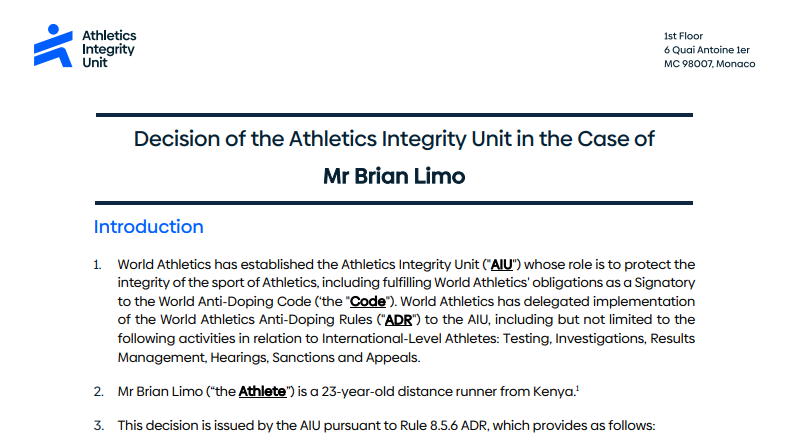
By Joel Masibo, January 26, 2026Athletics Integrity Unit (AIU) has slapped Kenya’s Brian Limo with a five-year ban over doping, based on a statement released by the body on Monday, January 26, 2026.
AIU argues that on Saturday, April 5, 2025, the 23-year-old long-distance athlete provided a urine Sample In-Competition at the ‘Drammen 10K-5K’ held in Drammen, Norway, which was given code 1587509.
On the same day, the World Anti-Doping Agency (“WADA”) accredited laboratory in Oslo, Norway, reported that the analysis of the Sample had revealed the presence of Salbutamol exceeding 1000ng/mL.
Prohibited substance
”The AIU reviewed the Adverse Analytical Finding in accordance with Article 5 of the ISRM and determined that the Athlete did not have a Therapeutic Use Exemption (“TUE”) that had been granted (or that would be granted) for the Salbutamol found in the Sample; and there was no apparent departure from the International Standard for Testing and Investigations (“ISTI”) or from the International Standard for Laboratories (“ISL”) that could reasonably have caused the Adverse Analytical Finding,” the statement read in part.
The AIU further reported that on Tuesday, May 8, 2025, in accordance with Article 5 of the International Standard for Results Management (“ISRM”) the AIU therefore issued the Athlete with a Notice of Allegation of AntiDoping Rule Violations, which notified the Athlete of the Adverse Analytical Finding and invited him to provide an explanation by no later than 15 May 2025. 9.
On Thursday, May 8, 2025, the Athlete provided the AIU with two medical documents from the Eldomart Medical Plaza (“the Medical Facility”) and a picture of Salbutamol tablets 4 mg. Both medical documents contained a prescription for Salbutamol (4mg tablets) to be taken once daily for five days and indicated that the Athlete attended the Medical Facility on 1 April 2025 complaining of headache, chest pain and difficulties in breathing. Furthermore, one document indicated that the Athlete was examined and underwent medical tests at the Medical Facility.
On the same day, the Athlete provided the AIU with the signed Admission of Anti-Doping Rule Violations and Acceptance of Consequences Form, accepting a period of ineligibility of two (2) years.
However, as the AIU noted several discrepancies in the medical documents submitted by the athlete, including different names for the doctor, inconsistencies in the medications the athlete had allegedly been prescribed, and one document submitted as an image appeared to be a screenshot of a Word document in the process of being edited, it decided to initiate an investigation.
ADAK assistance
Therefore, on Monday, May 14, 2025, the AIU requested assistance from ADAK in determining the authenticity of the medical documents submitted by Limo and whether he had attended the Medical Facility on Tuesday, April 1, 2025.
On Thursday, May 22, 2025, the AIU received an independent expert scientific opinion from Prof. Martial Saugy (on request), which confirmed his opinion was that “the concentration of salbutamol found in the athlete’s sample seems to be higher than what would be expected after the intake (even daily during 5 days) of 4 mg of salbutamol”.
On Thursday, June 5, 2025, ADAK provided the AIU with a copy of a letter from the Medical Facility, which confirmed that the Athlete did not attend on Tuesday, April 1, 2025.
Based on the above, the AIU considered the medical documents that the athlete had submitted to the AIU on Saturday, May 10, 2025, indicating that he had visited the Medical Facility, undergone tests and been prescribed Salbutamol on Tuesday, April 1, 2025, were fabricated/falsified documents.
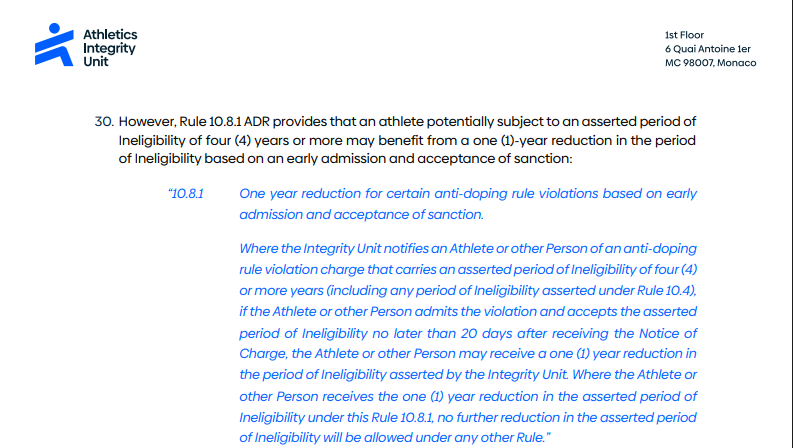
”Based on the Athlete’s interview, the AIU concluded that the Athlete had committed an Anti-Doping Rule Violation under Rule 2.5 ADR (Tampering or Attempted Tampering with any part of Doping Control by an Athlete). The AIU also remained satisfied that the Athlete had committed Anti-Doping Rule Violations under Rule 2.1 ADR, Rule 2.2 ADR based on the Adverse Analytical Finding.” The statement said.
However, if an appeal is filed against this decision by WADA or ADAK, the Athlete will be entitled to exercise his right of cross-appeal in accordance with Rule 13.2.4 ADR.