School reopening: Education Ministry clarifies when learners should report for Term Three
By Steve Ireri, August 20, 2026The Ministry of Education has moved to clear confusion over the reopening of schools, confirming that learners will report for the third term on Monday, August 24, 2026, as earlier scheduled.
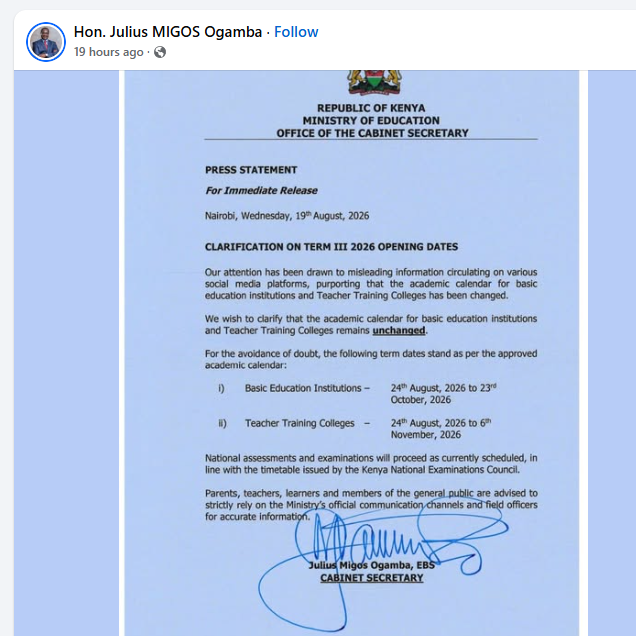
In a Facebook post on Thursday, August 20, 2026, Education Cabinet Secretary Julius Ogamba dismissed reports circulating on social media claiming that the government had postponed the reopening date to September, describing the notices as false and urging parents, teachers and learners to rely on official communication from the ministry.
“We wish to clarify that the academic calendar for Basic Education institutions and Teacher Training Colleges remains unchanged,” the CS said.
The clarification comes just days before the end of the three-week August holiday, with schools across the country preparing to receive learners for the final academic term of the year.
According to the ministry, pre-primary, primary, junior school, senior school and secondary school learners will all resume classes on August 24.
Term Three will run for nine weeks, ending on October 23, 2026, before learners proceed to the end-of-year break. The dates are contained in the approved 2026 academic calendar, which the ministry said remains unchanged.
Ogamba said the ministry had directed Regional Directors of Education, County Directors of Education and Sub-County Directors of Education to ensure schools comply with the approved calendar.
“Our attention has been drawn to misleading information circulating on various social media platforms, purporting that the academic calendar for basic education institutions and Teachers Training Colleges has been changed,” the CS affirmed.
Reporting time
As learners prepare to return, Ogamba also clarified the hours within which day schools should operate, amid concerns over institutions requiring learners to arrive unusually early.
Speaking in the National Assembly on Thursday, August 20, the CS said 7:15 am is the earliest time a day school can require a learner to report.
He said this requirement is provided for under Regulation 84 of the Basic Education Regulations, 2015.
Importantly, however, Ogamba clarified that 7:15 am is not the beginning of classroom instruction.
“The earliest permissible reporting time is 7.15 a.m., while the prescribed class hours commence from 8 a.m. and end at 3.30 p.m.,” he said.
The regulations apply to both public and private day institutions.
\

Under the framework, formal classroom instruction is scheduled to run from 8:00 am to 3:30 pm, while co-curricular activities can continue from 3:30 pm to 4:45 pm.
This means schools cannot use the period before 8:00 am to impose formal classroom lessons simply because learners have reported by 7:15 am.
Crucial term
The third term will be particularly significant for candidates preparing for the national assessments and examinations scheduled immediately after the teaching period.
The ministry has confirmed that the national examination calendar remains unchanged, with the assessments beginning from October 26, 2026.
The 2026 calendar provides for the Kenya Primary School Education Assessment (KPSEA), Kenya Intermediate Level Education Assessment (KILEA), Kenya Junior School Education Assessment (KJSEA) and Kenya Pre-Vocational Level Education Assessment (KPLEA) to take place around the end of October and into early November.
The compressed nature of the final term means schools will have a limited period to complete teaching, revision and examination preparations before candidates begin their national assessments.
According to the approved calendar, activities and visits to secondary schools will remain banned during Term Three, allowing institutions to concentrate on learning and preparations for national assessments and examinations.
The restriction is part of the ministry’s existing guidelines for the examination-focused final term.