Advertisement
Govt to prioritise Kenyan doctors and nurses in new licensing policy
07th January, 2026 10:20 PM

The government has announced a new health workforce licensing policy that will prioritise the licensing and deployment of qualified Kenyan doctors, nurses, clinical officers, and specialists before considering the routine licensing of foreign health professionals.
In a statement on Wednesday, January 7, 2026, the Ministry of Health said the move is aimed at protecting local professionals and maximising returns on the significant public investment made in training Kenya’s health workforce.
The ministry noted that Kenyan taxpayers fund medical education at both the undergraduate and postgraduate levels, making it necessary and fair to give first priority to locally trained practitioners to serve in the country.
The policy, according to the ministry, is aligned with international best practice and is supported by guidance from global bodies such as the International Labour Organisation (ILO) and the World Health Organisation (WHO).
These institutions consistently recommend that countries prioritise employment opportunities for their own qualified health workers as part of national workforce planning, system sustainability, and resilience.
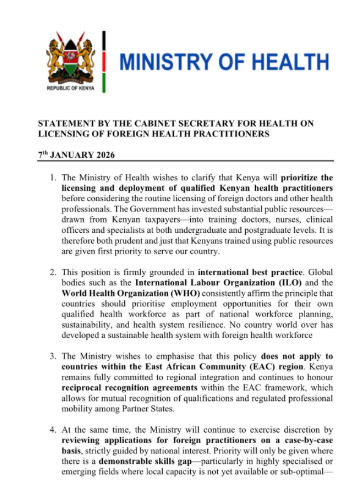
However, the government clarified that the policy will not apply to countries within the East African Community (EAC).
“The Ministry wishes to emphasise that this policy does not apply to countries within the East African Community (EAC) region. Kenya remains fully committed to regional integration and continues to honour reciprocal recognition agreements within the EAC framework, which allows for mutual recognition of qualifications and regulated professional mobility among Partner States.”
At the same time, the Ministry of Health said it will continue to review applications from foreign health practitioners on a case-by-case basis, guided strictly by national interest.
Priority consideration will only be given where there is a clear skills gap, particularly in highly specialised or emerging fields where local capacity is unavailable or insufficient.
Such engagements, the ministry said, must also support knowledge transfer and strengthen the health system.
Additionally, the government stressed that the policy is neither isolationist nor unique to Kenya, noting that many countries, including high-income nations, apply similar frameworks that favour local professionals while allowing limited and carefully regulated entry of foreign practitioners in exceptional circumstances.

The ministry also cited patient safety and professional integrity as key drivers of the new policy, revealing concerns over cases where individuals seek registration to practise in Kenya despite lacking proper recognition, licensure, or good standing in their countries of origin. International regulatory norms, it said, require host countries to prevent such practices to safeguard patients and curb professional misconduct.
“As the custodian of Kenya’s health security, the Ministry will continue to work through statutory regulatory bodies to ensure that licensing decisions uphold patient safety, professional integrity, and national workforce sustainability, while remaining compliant with Kenyan law and international obligations.”
Furthermore, the Ministry affirmed that Kenya’s position is lawful, globally aligned, and clear: qualified Kenyans will come first, regional obligations will be respected, and foreign practitioners will only be engaged where they add clear value and meet the highest ethical and professional standards.