Bill Gates’ foundation debunks claims it’s releasing lab-grown mosquitoes in Kenya
By Paulette Mboga, February 9, 2026The Bill Gates Foundation Africa has dismissed claims circulating on social media that it is releasing mosquitoes in Kenya.
The foundation on a post on X on Monday, February 9, 2026, said these claims are false, adding that it does not operate laboratories that release mosquitoes or carry out vector-control activities in Nairobi or anywhere else.
As per the statement, malaria prevention and control efforts in Kenya are led by local authorities and institutions following national laws and regulations.
“We are aware of social media posts claiming that we release mosquitoes in Kenya. This claim is false,” the foundation said.
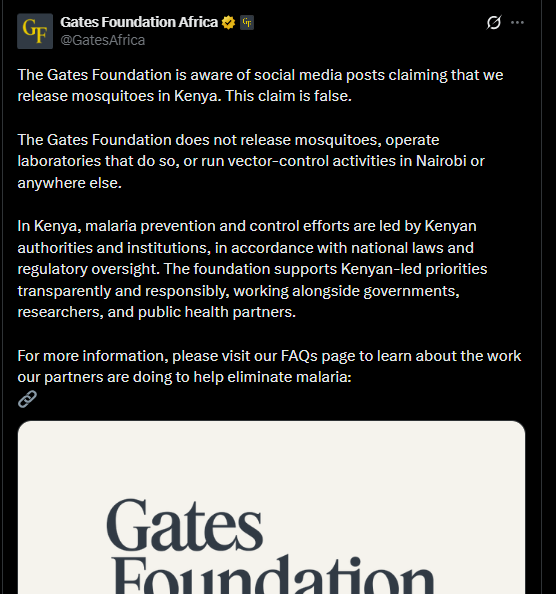
It explained that all its work in Kenya is aligned with Kenyan-led priorities and conducted transparently with governments, researchers, and public health partners.
Kenyan institutions remain responsible for malaria control, with the foundation providing support rather than direct implementation. The Gates Foundation stressed that its role is advisory and funding-based, working within legal and regulatory frameworks.
“The foundation does not release mosquitoes, operate laboratories that do so, or run vector-control activities in Nairobi or anywhere else,” it added.
Health initiative draws attention across Africa
Just last month, according to an article by Business Insider Africa, the foundation, in partnership with OpenAI, launched a Ksh6.5 billion artificial intelligence-driven health initiative targeting African healthcare systems.
Rwanda will serve as the pilot country for the Horizon1000 programme, which aims to support 1,000 primary healthcare clinics by 2028. Bill Gates said artificial intelligence could help close critical healthcare gaps in low-income countries.

According to the foundation, the project will focus on clinical decision support, disease surveillance, and improving administrative efficiency in healthcare delivery.
Despite these assurances, the announcement triggered fierce criticism online. The majority of Africans on social media expressed scepticism about foreign-led health interventions, reflecting long-standing trust issues across the continent.
Misinformation around both malaria control and new AI initiatives shows that there is a need for better communication about foreign-funded health programmes.
For now, the foundation maintains that its interventions are strictly advisory and funding-focused. It insists there is no release of mosquitoes and no laboratory operations linked to its malaria programmes, countering false claims that have gained traction on social media.