Kenya turns to newborn screening to catch hearing loss before it’s too late
By Willow Health, August 8, 2026The country’s first structured universal newborn hearing screening service is a step towards catching hearing loss before babies leave the hospital, rather than after developmental delays surface.
Kenyatta University Teaching, Referral and Research Hospital (KUTRRH) has been designated Kenya’s national Centre of Excellence for Ear and Hearing Care, making it the country’s first one-stop referral facility for hearing services, spanning newborn screening, diagnosis, rehabilitation, assistive technology and follow-up care.
For the estimated one million Kenyans living with hearing loss, and the thousands of children among them whose conditions go undiagnosed each year, it could mark a turning point in how early the country catches a condition that is often invisible until it is too late.
Agnes Silayo understands that urgency better than most. She had spent years communicating with her son through sign language after doctors told her, when he was still an infant, that he could not hear. Then, at KUTRRH, he said “baba” (dad) for the first time.
“It was the first word I had ever heard him say,” Silayo recalls, smiling through tears. “I had always hoped that one day my child would speak.”
Her son’s breakthrough came through a hearing aid fitting programme run by KUTRRH with the Clinton Health Access Initiative (CHAI Kenya), the Ministry of Education and other partners.
Silayo’s story illustrates what specialists have argued for years: untreated hearing loss does not just take away sound. It delays speech, undermines learning, isolates children socially, and strains families emotionally and financially, damage that is largely preventable when caught early.
Because hearing loss is often silent
For Moses Mati, the signs were there long before anyone noticed. His daughter, Gracious Wavinya, always turned the television volume unusually high. He assumed it was habit. Her hearing loss was only detected when specialists visited her school during a nationwide screening exercise.
“I had no idea my daughter had a hearing problem,” Mati says. “Today, I thank God and this program because they identified the problem before it was too late.”
That gap between onset and discovery is the central problem Kenya’s hearing care system is now trying to close.
Because the condition is often silent, many children are diagnosed only after they fall behind in school or withdraw socially, by which point months or years of development may already be lost.
To intervene earlier, KUTRRH, CHAI and the Ministry of Education have now moved screening into schools. Clinical audiologist Akoth Oriang says the goal was to catch difficulties before they permanently affected a child’s education.
“Our goal was to identify children who needed hearing assistive devices before their hearing loss continued affecting their education and development,” she says.
The exercise screened roughly 356 school-going children, identified 75 who needed intervention, and has fitted 50 with hearing aids so far, a lifeline Mati says would otherwise have been financially out of reach.
Fitting a hearing aid, though, is only the starting point. Every child undergoes a detailed assessment before specialists programme the device to their specific degree of loss.
“Hearing loss ranges from mild to profound, so every device must be customised,” Oriang says. “We are introducing these children to better listening so they can improve academically, interact confidently with their peers and feel included instead of being sidelined.”
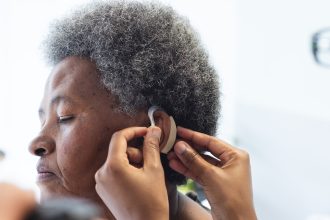
Children who have lived with hearing loss must train their brains to recognise sounds that were previously absent or distorted
Silayo’s son later enrolled in a school for children with hearing impairment, where he learnt sign language, and it was there that specialists made an unexpected discovery.
“When specialists came to the school, they discovered that one ear had started responding. They asked me to sign consent forms so the process of getting a hearing aid could begin,” she says. Today she advocates for early diagnosis. “Never give up on your child. Don’t keep them hidden at home because they have a disability. Take them to school, look for help and love them. Every child deserves an opportunity.”
A hearing aid, however, does not by itself restore language. Children who have lived with hearing loss must train their brains to recognise sounds that were previously absent or distorted; a process that can take months or years and depends heavily on family involvement.
Claudius Chepkemoi, an auditory verbal therapist at KUTRRH, says many parents assume speech follows automatically once a child is fitted with a device.
“Hearing aids provide children with access to speech sounds, but they do not automatically enable them to develop spoken language. Our work is to teach the brain how to make sense of these new sounds,” she says.
Unlike conventional therapy centred on the child alone, auditory verbal therapy puts parents at the heart of rehabilitation, turning everyday routines like mealtimes, play, reading, and dressing into opportunities for listening and language practice.
“We work directly with parents and caregivers because therapy should not stop within hospital walls,” Chepkemoi says. Progress varies: some children respond within weeks, others need much longer, depending on severity, age at diagnosis and how consistently rehabilitation continues at home.
Every baby born at KUTRRH should eventually be screened before discharge or within the first month
It is this full continuum from diagnosis, technology and therapy that KUTRRH’s new status is designed to bring under one roof. Dr Lilian Wairimu Mokoh, an Ear, Nose and Throat (ENT) surgeon and cochlear implant specialist, says the designation marks a shift away from hearing care confined to ENT clinics and towards a system that catches hearing loss at every stage of life.
“This means we will become a one-stop centre for hearing care in Kenya, from screening and diagnosis to hearing rehabilitation, fitting assistive hearing technologies and long-term follow-up,” she says.
At the centre of that shift is universal newborn hearing screening. Dr Mokoh says every baby born at KUTRRH should eventually be screened before discharge or within the first month, with diagnosis confirmed by three months and intervention starting before six months, which is the window experts consider critical for speech, language and cognitive development. The aim is to catch hearing loss before parents even suspect a problem.
“Hearing loss is often invisible. You cannot simply look at someone and know they have a hearing problem. That is why we must actively screen people throughout their lives,” she says.
Screening will extend beyond ENT departments into maternal and child health clinics, immunisation visits, nutrition and diabetes clinics, oncology services, schools and outreach for older adults, making hearing assessment routine rather than a response to symptoms already present.
This expansion is being tested through a two-year pilot backed by Hear the World Foundation, CHAI Kenya and Global OHNS, designed to generate evidence for national policy, particularly on affordability.
“The purpose is to generate evidence on how hearing services can be delivered effectively, affordably and equitably. Hearing technologies are expensive and many people who need them come from low-income families. We want evidence that will inform national policy and support universal access,” Dr Mokoh says.
Hearing loss affects more than one million Kenyans and carries lifelong consequences for communication, education and social inclusion
Early results suggest the approach is working. Health Cabinet Secretary Aden Duale says school and community screening has identified more than 900 children needing hearing services, of whom about 100 have received hearing aids through KUTRRH. Around 80 high-risk newborns have also been screened, an early sign that hearing checks can fit into routine maternity care.
Speaking at KUTRRH’s Second Scientific Conference on July 1, 2026, Duale said hearing loss affects more than one million Kenyans and, left undetected, carries lifelong consequences for communication, education and social inclusion.
Building on that momentum, Duale announced that KUTRRH will establish Kenya’s first structured universal newborn hearing screening service within the public health system, a step towards catching hearing loss before babies leave hospital rather than after developmental delays surface.
“This is a landmark initiative for our country. Early diagnosis means timely intervention, ensuring children receive the care they need during the most critical stages of development,” he said.
Cost remains the biggest obstacle to scaling this nationally, and the government says it will address it directly. Duale pledged to push for hearing services to be added to the Social Health Authority (SHA) benefits package.
“We are already paying up to Ksh800,000 under SHA benefits. We shall engage the Benefits Advisory Panel so that these services are included because these families are special. Every Kenyan deserves equal access to healthcare,” he said. If adopted, the move would remove one of the biggest barriers keeping families from specialist care.
Together, the school screenings, the auditory verbal therapy model and the newborn screening pilot outline a clear path: catch hearing loss at birth, fit and calibrate the right device, and surround the child with therapy that trains parents as much as the child. For a country where hearing loss has long stayed invisible until it disrupts a child’s schooling, KUTRRH’s designation offers a system built to find children before their hearing loss finds them first.