From speeding to dirty seatbelts: Everything you need to know about NTSA instant fines
By Mabonga Makhanu, June 6, 2026Motorists would have been required to pay a Ksh500 instant fine for failing to wear a seatbelt or for having dirty and unwearable seatbelts had the National Transport and Safety Authority’s (NTSA) proposed instant fines framework taken effect.
The instant fines framework was introduced through Legal Notice No. 161, the Traffic (Minor Offences) Rules, 2016, developed jointly by the Office of the Director of Public Prosecutions (ODPP) and the Ministry of Transport.
The framework sought to allow motorists and other road users who commit minor traffic offences to pay prescribed penalties instantly through the eCitizen platform instead of undergoing lengthy court processes.
Under the proposed framework, offenders would receive a notification detailing the offence committed and the corresponding penalty. Payments would then be made digitally through eCitizen using M-Pesa, debit cards, or credit cards.
The framework covered a wide range of offences, including speeding, driving without proper documentation, failure to obey traffic signs, using mobile phones while driving, seatbelt violations, motorcycle safety breaches, and public service vehicle offences.
Speeding penalties
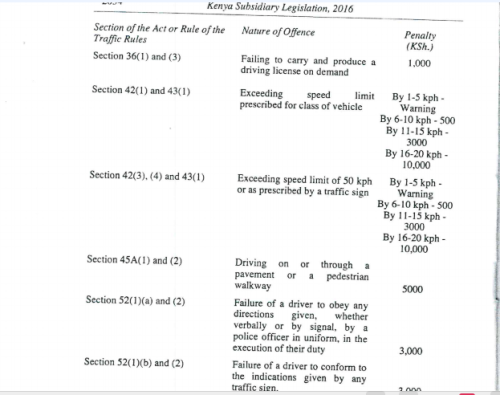
Under the proposed minor traffic offences framework, speeding penalties would have been structured based on the severity of the offence.
Motorists exceeding the speed limit by 1–5 km/h would receive an official warning, while those exceeding it by 6–10 km/h would be fined Ksh500. Drivers exceeding the limit by 11–15 km/h would pay Ksh3,000, while those surpassing it by 16–20 km/h would face a Ksh10,000 penalty.
“IN EXERCISE of the powers conferred by section 117 of the Traffic Act, the Cabinet Secretary for Transport, Infrastructure, Housing and Urban Development makes the following Rules.”
“THE TRAFFIC (MINOR OFFENCES) RULES, 2016″ 1. These Rules may be cited as the Traffic (Minor Offences) Rules, 2016. 2. The minor traffic offences which may be dealt with and prosecuted in accordance with the provisions of section 117 of the Act shall be those specified in the First Schedule.”
Licensing penalties
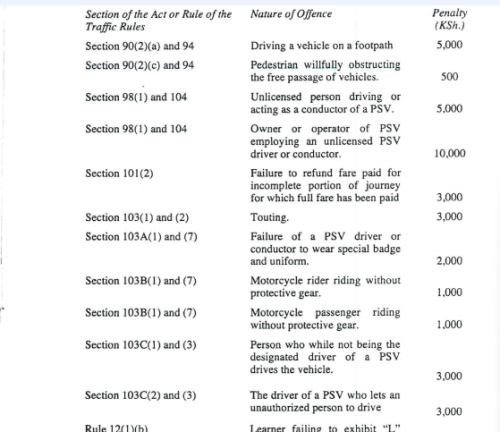
Documentation and licensing violations also attracted hefty penalties. Driving without properly affixed number plates or operating a vehicle without a valid inspection certificate would have resulted in a Ksh10,000 fine.
Motorists driving without the correct class endorsement would have paid Ksh3,000, while failure to renew a driving licence, produce it on demand, or display “L” plates for learner drivers would have attracted a Ksh1,000 fine.
The framework also targeted driver conduct and road safety violations. Causing a traffic obstruction through improper parking or positioning would have attracted a Ksh10,000 fine. Drivers who failed to stop when directed by a uniformed police officer or drove on footpaths and walkways would have been fined Ksh5,000.
Disobedience to traffic lights
Motorists who failed to obey traffic signs, ignored instructions from police officers, or failed to display reflective triangles during a breakdown would have paid Ksh3,000.
Additionally, using a mobile phone while driving or failing to carry lifesavers would have attracted a Ksh2,000 fine, while allowing any part of a passenger’s body to protrude from a moving vehicle would have resulted in a Ksh1,000 penalty.
Motorcycle riders and passengers without protective gear would each have been fined Ksh1,000, while carrying more than one pillion passenger would have attracted a similar penalty.
Public service vehicles (PSVs) were also targeted under the proposed framework. Failure to install a prescribed speed governor would have attracted a Ksh10,000 fine.
Driving a PSV while unqualified would have cost Ksh7,000, while employing an unlicensed driver or operating as an unlicensed conductor or driver would have resulted in a Ksh5,000 penalty. Touting would have attracted a Ksh3,000 fine, while picking up or dropping passengers at undesignated locations would have cost Ksh1,000.
How to pay
Even pedestrians were not spared under the proposed regulations. Anyone found wilfully obstructing the free passage of vehicles would have been liable to a Ksh500 fine.
The proposed penalties were to be processed through the eCitizen platform, with motorists and other offenders required to make payments digitally via M-Pesa using the provided invoice Paybill number or through debit and credit cards.
However, the implementation of the instant fines framework was halted after it was