5 frequently used words in a police station you probably did not know
By David Nthua, January 26, 2026Police officers in Kenya are revered, respected and honoured in equal measure.
To many Kenyans, their safety at one point or another has been made possible by men and women in uniform.
To others, a police station has been a place of relief during distressing moments.
However, despite frequent interactions with police stations across the country, many Kenyans walk in and out without fully understanding the vocabulary used inside.
These words are often mentioned casually by officers, yet they carry specific meanings that can shape how a case progresses.
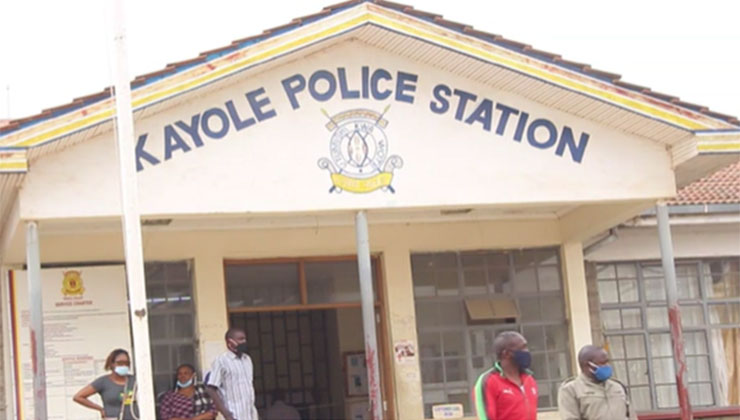
Here are five frequently used police station words that many Kenyans hear but rarely understand.
Occurrence Book
The Occurrence Book, commonly referred to as OB, is one of the most important documents in any police station. Every report made by a member of the public is first recorded here.
When you report theft, assault or loss of documents, the officer writes the details in the OB and assigns an OB number.
This number acts as proof that you reported the matter and helps track the case.
Many Kenyans leave police stations without insisting on an OB number, yet without it, follow up becomes difficult.
The OB is not a suggestion or favour. It is a legal record recognised under the National Police Service Act.
OCS
OCS stands for Officer Commanding Station. This is the senior officer in charge of a specific police station.
The OCS oversees all operations, discipline and decision making within that station.
When officers say a matter needs approval from the OCS, it means the issue requires the authority of the station commander.
Many Kenyans assume the OCS only appears in serious cases, but they play a daily role in supervision, conflict resolution and accountability.
If you feel your case is being mishandled, the OCS is often the first senior officer you can request to see.
Cash bail
Cash bail is one of the most misunderstood terms in Kenyan police stations. It refers to money paid to secure temporary release of a suspect while investigations continue.
Cash bail is not a fine and does not mean a person is guilty. It is a guarantee that the suspect will return to the station or court when required.
The amount is usually refundable once the case concludes, provided the suspect honours all reporting conditions.
Many Kenyans confuse cash bail with bribery, yet it is a lawful process governed by police and criminal procedure laws.
P3 form
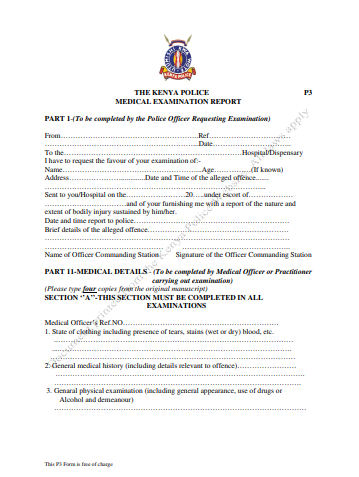
The P3 form is a medical document used mainly in assault and sexual offence cases. After reporting such an incident at a police station, the complainant is issued with a P3 form.
A doctor then examines the victim and records medical findings on the form. This document becomes key evidence in court.
Without a properly filled P3 form, proving physical harm becomes difficult.
Many cases collapse because victims delay medical examination or do not understand the importance of this form.
DCIO
DCIO stands for Directorate of Criminal Investigations Officer in charge of a station or sub county. Unlike regular officers who handle general duties, the DCIO focuses on investigations.
Cases involving fraud, serious theft, murder or complex crimes are often handled under the DCIO.
When officers mention that a file has been forwarded to the DCIO, it means the matter has moved to an investigative stage.
Understanding this term helps manage expectations. Investigations take time and involve evidence gathering, witness statements and legal review.