Can Kenyan Gen Z break free from black tax?
By Valerian Khakayi, August 26, 2025Let’s say you are a young Kenyan who has a payslip. Most likely, you are already aware of the black tax,which is the implicit expectation that once you begin earning money, you will be able to support your extended family.
The phone starts ringing before you even consider saving money or treating yourself: your mother’s chama contribution is due, your sibling needs school fees, or you have to shop at home.
Many young people feel overburdened by the responsibility because of the high cost of living and low salaries. This has swiftly emerged as one of the most contentious challenges of adulthood for Gen Z.

Frastructions
For many Gen Z Kenyans, that emotional blackmail feels heavier than the money itself. Saying “no” often comes with guilt, accusations of being ungrateful, or comparisons to other relatives who “never forget home.”
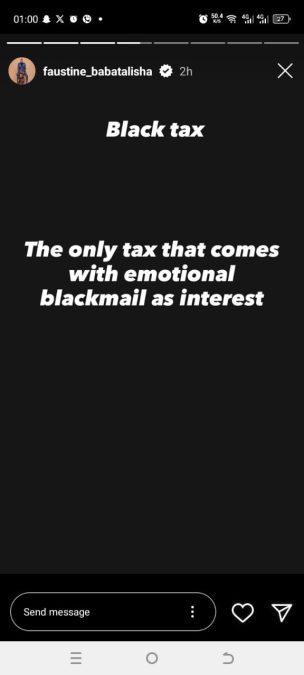
On August 14, 2025, Kenyan digital content creator and photographer Faustine Lukale Baba Talisha shared his thoughts on the concept of black tax, which most Kenyans say places an unfair financial and emotional burden on them.
He described the Black tax as the only tax that comes with emotional blackmail as interest, explaining that, beyond the monetary demands, there is often pressure and guilt used to compel one to give.
According to Baba T, while supporting family is important, the expectations can sometimes become overwhelming, especially when they are tied to emotional manipulation.
“Black tax. The only tax that comes with emotional blackmail as interest,” Baba Talisha shared.
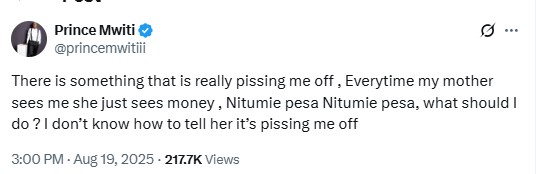
Another TikToker, Prince Mwiti, took to his X account to vent his frustration about the black tax. He said that what really pissed him off was that every time his mother saw him, she only saw money, constantly asking him to send cash.
He added that he didn’t know how to tell her it was upsetting him.
“There is something that is really pissing me off. Every time my mother sees me, she just sees money, Nitumie pesa Nitumie pesa, what should I do? I don’t know how to tell her it’s pissing me off,” he lamented.
Their feelings are echoed by many young Kenyans who are now using TikTok, X, and Facebook to vent about the black tax.
Supporters
However, supporters of the black tax argue that it helps lift entire families out of poverty and is a form of social security in communities where formal systems are lacking.
Black tax is more than just a financial obligation. For many, it’s a balancing act between gratitude, responsibility, and the need for personal growth.
At the end of the day, the big question remains: can Gen Z truly break free from black tax, or will the cycle continue with the next generation?