Octopizzo criticises ODM, says it is eroding from within
By Paulette Mboga, February 7, 2026Kenyan rapper and youth advocate Henry Ohanga, popularly known as Octopizzo, has criticised the ODM party, warning that it is losing its moral direction due to internal failures rather than outside pressure.
In a long post on X on Saturday, February 7, 2026, he says the movement is slowly breaking down as personal interests take priority over shared values and long-term purpose.
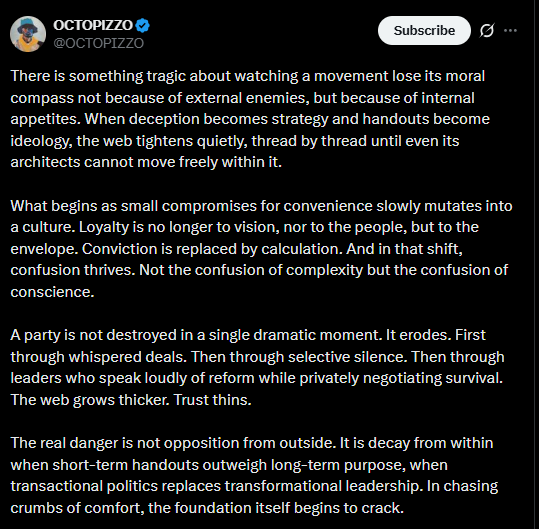
“There is something tragic about watching a movement lose its moral compass not because of external enemies, but because of internal appetites,” Octopizzo says.
He argues that the danger facing ODM is not political rivalry, but choices being made from within its own ranks.
The artist says the shift begins quietly.
“When deception becomes strategy, and handouts become ideology, the web tightens quietly, thread by thread,” he says, warning that even those who design such systems eventually become trapped by them.
Octopizzo explains that what starts as small compromises soon turns into an accepted way of doing things.
“What begins as small compromises for convenience slowly mutates into a culture,” he says, describing a steady change that weakens the party’s foundation.
The slow erosion of trust
According to Octopizzo, loyalty within the party has changed.
“Loyalty is no longer to vision, nor to the people, but to the envelope,” he says, adding that values are being replaced by self-interest and calculation.
He notes that this shift creates confusion, not because issues are complex, but because principles are no longer clear.
“Conviction is replaced by calculation,” Octopizzo says, “In that shift, confusion thrives. Not the confusion of complexity but the confusion of conscience.”
The criticism goes further, with Octopizzo saying that the damage does not happen overnight.
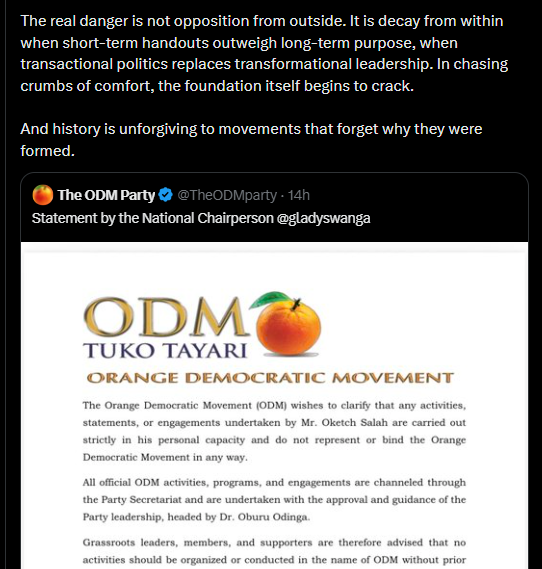
“A party is not destroyed in a single dramatic moment,” he says. “It erodes.” He outlines a pattern that begins with “whispered deals,” followed by “selective silence.”
He also aims for leadership behaviour.
“Then through leaders who speak loudly of reform while privately negotiating survival,” he says, arguing that mixed signals weaken trust and direction.
Octopizzo says the result is a tightening grip that is hard to escape.
“The web grows thicker. Trust things,” he says, describing a movement slowly losing its strength from the inside.
According to him, transactional politics is replacing meaningful leadership.
“When transactional politics replaces transformational leadership,” he says, “the foundation itself begins to crack.”
This comes amid the latest exchange of statements between Homa Bay Governor Gladys Wanga and Oketch Salah.