Janet Mbugua compares Gen Z and millennials in toxic workplace culture
By Paulette Mboga, September 6, 2026Janet Mbugua has spoken about changing attitudes towards toxic workplace culture, noting that Gen Z is refusing to accept it while millennials, who helped build hustle culture, are now walking away from it.
Mbugua said conversations around workplace culture have been coming up repeatedly and that Kenyans need to become more comfortable with difficult discussions. She explained that different generations are now pushing back against issues that were once accepted in workplaces.
“This conversation has been coming up over and over. It is important that, as a society, as Kenyans, we get familiar with uncomfortable conversations. A lot of generations that are coming now are pushing back, which is good,” Janet Mbugua said on Sunday, September 6, 2026.
Mbugua said the people behind toxic workplaces are not always the ones who speak the loudest. She explained that workplace decisions can also be influenced by people within an inner circle, including decisions about who receives protection and who is left to deal with the consequences.
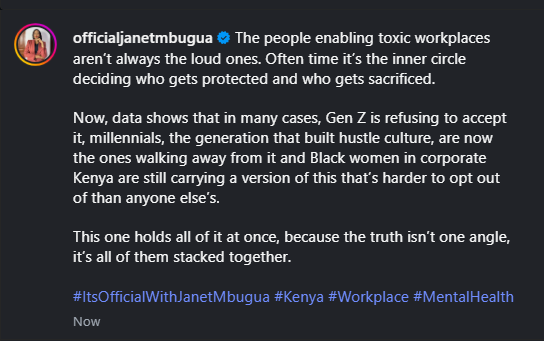
“The people enabling toxic workplaces aren’t always the loud ones. Often it’s the inner circle deciding who gets protected and who gets sacrificed,” Janet Mbugua said.
Gen Z and millennials push back
Mbugua pointed to the different ways generations are responding to workplace culture. She said Gen Z is refusing to accept toxic workplaces, while millennials are also changing their approach after being linked to the hustle culture that shaped their generation.
“Now, data shows that in many cases, Gen Z is refusing to accept it; millennials, the generation that built hustle culture, are now the ones walking away from it,” Janet Mbugua said.
She also noted that Black women in corporate Kenya continue to face a version of the workplace experience that is harder to leave behind. Mbugua said the issue cannot be viewed from only one side because different experiences form part of the same discussion.

Mbugua explained that the conversation includes the actions of inner circles, changing views among generations and the experience of Black women in corporate Kenya. She said these issues come together when discussing toxic workplace culture and the changes taking place.
“This one holds all of it at once, because the truth isn’t one angle; it’s all of them stacked together,” Janet Mbugua said.
She said the willingness of newer generations to push back is important as Kenyans continue having uncomfortable conversations about workplaces and the experiences of different groups.