Octopizzo defends Kenya’s matatu culture, urges focus on governance
By Faith Lagat, July 19, 2025Kenyan rapper and cultural icon Octopizzo has defended the country’s matatu culture, describing it as a powerful platform for creativity, economic empowerment, and youth expression.
In a detailed post on X early Saturday, July 19, 2025, the artist urged Kenyans to move beyond political sideshows and focus on the deeper issues of governance.
Octopizzo’s remarks come as public conversations swirl around matatu culture, especially after George Ruto, son of President William Ruto, publicly aligned himself with the industry. While recognising George’s support, Octopizzo warned against linking the culture to political endorsement.
“It’s important, however, to make a clear distinction: while individuals like George Ruto support and appreciate matatu culture, this doesn’t automatically mean the culture endorses the political regime,” he wrote.
“The enemy is not George; the enemy is bad governance and killer government. Ma3 Culture is a reflection of the people—complex, independent, and often resistant to co-option,” read the post.
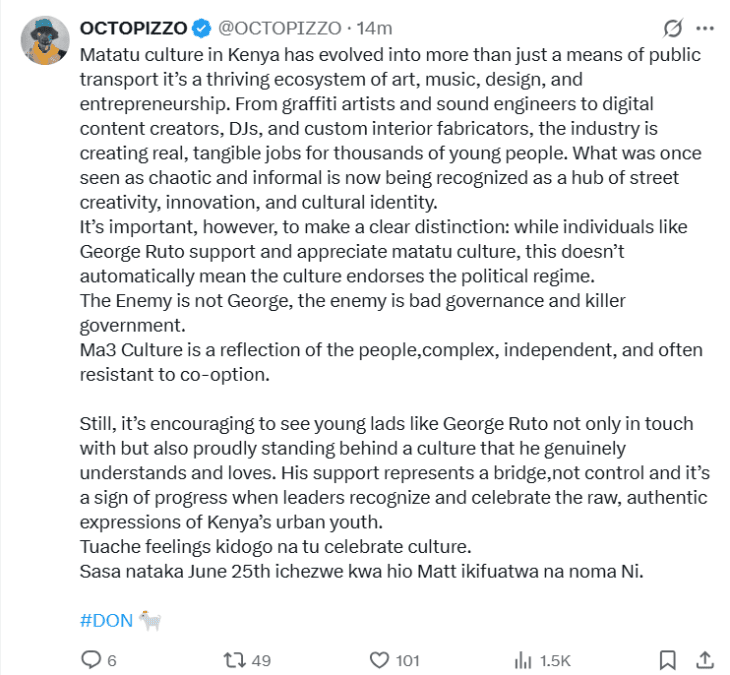
Matatu culture, he noted, has transformed over time from a chaotic informal sector into a vibrant industry employing graffiti artists, DJs, sound engineers, content creators, and custom interior designers. He pointed to its role in job creation for thousands of young Kenyans.
His sentiments are supported by a 2019 University of Nairobi study estimating that the matatu industry provides employment for more than 150,000 people.
A 2024 ethnographic report in the Journal of African Cultural Studies further highlighted the matatu’s role as a symbol of urban identity and resilience.
Separating culture from politics
Octopizzo was careful to distinguish cultural appreciation from political alignment. He cautioned against assuming that George Ruto’s support equates to the culture’s endorsement of the political regime.
He described matatu culture as a mirror of Kenya’s street life—complex, independent, and resistant to political co-option. According to him, the real problem lies in poor governance, not individuals like George Ruto who show interest in street culture.
This message resonates with Kenya’s youth, many of whom participated in the 2024 and 2025 protests against police brutality and government failures. These protests were documented by the Council on Foreign Relations, underscoring a growing demand for accountability.
Still, Octopizzo welcomed George Ruto’s involvement, saying it reflects progress when leaders engage with the raw, authentic expressions of Kenyan urban life. He urged young people to see this engagement as a bridge rather than an attempt at control.
Celebrate creativity
In his closing remarks, Octopizzo called for a shift from political tensions to cultural celebration. He referenced June 25th—the anniversary of last year’s youth protests—as a day to commemorate resilience through music, matatu artistry, and street culture.
Octopizzo’s message highlights the global reach of Kenya’s matatu culture, which continues to gain traction in international art and music circles.
His call to focus on governance rather than political personalities may resonate deeply as the country navigates its current social and political crossroads.