Wamae calls for health reforms in detention facilities
By Faith Lagat, July 25, 2025In a thought-provoking X post on July 25, 2025, former Roots Party deputy presidential candidate Justina Wamae has ignited fresh debate around healthcare rights and patient safety in Kenya’s detention and hospital systems.
Her remarks follow a series of disturbing security lapses at Kenyatta National Hospital (KNH), including two separate killings within the facility that have left the public alarmed and raised concerns over internal security.
The latest case involves Kennedy Kalombotole, a person of interest in the murder of Edward Maingi Ndegwa, a patient at KNH’s Ward C.
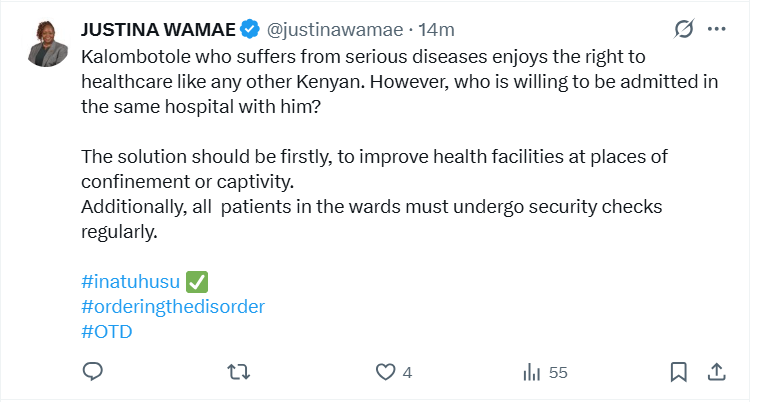
Wamae questioned the safety of admitting high-risk individuals in public hospitals, writing, “Kalombotole, who suffers from serious diseases, enjoys the right to healthcare like any other Kenyan. However, who is willing to be admitted to the same hospital with him?”
Her comments come just a day after a Kibera court, presided over by Magistrate Daisy Mutai, directed that Kalombotole be transferred to Mbagathi Hospital under tight security for ten days to receive medical attention, including insulin for blood sugar regulation and treatment for seizures and nausea.
The court order ensures that Kalombotole receives necessary care as detectives from the Directorate of Criminal Investigations (DCI) pursue forensic analysis, DNA sampling, and mental health evaluations to determine the circumstances surrounding Ndegwa’s death.
Hospital violence
The July 17 murder of Ndegwa is the second of its kind in recent months at KNH. In February 2025, a 39-year-old patient was found dead with a slit throat, with post-mortem results confirming he was attacked with a knife by an unknown assailant. The recurrence of such incidents has amplified scrutiny of the hospital’s safety protocols, especially in general wards shared by civilians and vulnerable individuals.
Wamae’s call for structural changes is timely. “The solution should be, firstly, to improve health facilities at places of confinement or captivity. Additionally, all patients in the wards must undergo security checks regularly,” she proposed. Her sentiments align with a 2024 United Nations recommendation urging member states to uphold humane but secure treatment of detainees.
Data from a 2021 study published in the Journal of Forensic Sciences estimates that one in every 500 hospital patients globally may pose a potential threat to others, reinforcing the need for tightened security in public health institutions.
Balancing rights and public safety
Kalombotole’s case has reignited the debate over how best to balance individual healthcare rights with the need to protect the broader patient community. Since his ICU admission in 2022, Kalombotole has remained at KNH due to homelessness, becoming a familiar figure within the facility.
Wamae’s remarks also point to broader systemic failures. According to a 2023 World Bank report, only 20 per cent of Kenyans have consistent access to medical coverage. As Mbagathi Hospital contends with overcrowding and limited capacity, Wamae’s push for dedicated health centres for incarcerated or high-risk patients could offer a long-overdue policy rethink.
Her intervention has sparked a national conversation on the safety of shared health spaces, potentially paving the way for new frameworks that respect both justice and the sanctity of human life.