Police sound alarm over terror, smuggling and IEDs in North-Eastern
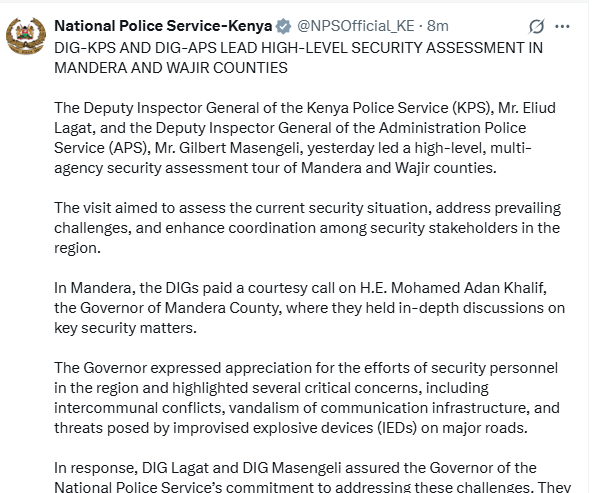
By Aloys Michael, August 10, 2025A top-level security delegation led by Deputy Inspector General of the Kenya Police Service (KPS), Eliud Lagat, and his counterpart from the Administration Police Service (APS), Gilbert Masengeli, conducted a critical multi-agency security assessment tour in Mandera and Wajir counties, amid rising security threats in the volatile northeastern region.
The tour comes at a time when northeastern Kenya faces a complex blend of terrorism, organised crime, and socio-political instability.
The high-stakes mission, which involved on-ground evaluations, high-level briefings, and multi-agency coordination meetings, comes in the wake of increasing concerns over terrorism, cross-border incursions, smuggling, and resource-driven conflicts.
In Mandera, the DIGs held talks with Governor Mohamed Adan Khalif, who raised several urgent issues, including intercommunal clashes, destruction of communication infrastructure, and the persistent danger of IED attacks on key road arteries.
“These are not just operational issues. These are threats that are stifling the region’s development and putting civilian lives at constant risk,” the statement read on the police X account on Sunday, August 10, 2025.
DIG Lagat assured the county of the National Police Service’s readiness to act decisively.
“We are reviewing deployment structures, enhancing support, and reinforcing our presence in high-risk zones,” he said.
At Mandera County Police Headquarters, the DIGs led a closed-door briefing focused heavily on threats emanating from the porous Kenya-Somalia border, including cross-border terrorism, Al-Shabaab activities, and arms trafficking.
The senior officers also met with frontline personnel from various units, including the KPS, Border Police Unit, RDU, GSU, and NPR. In a clear directive, DIG Masengeli urged officers to prioritise intelligence-sharing and operational synergy.
“We must dismantle the silos and work as one force against enemies that are adapting every day,” he said.
Later in Wajir, the DIGs chaired a security review with local commanders, where contraband smuggling, inter-community disputes, and human trafficking topped the agenda.
“We cannot allow criminal networks to exploit gaps in our policing or logistics. Our unity, discipline, and coordination will determine our success,” Lagat warned.

Beefing fight against insecurity
Meanwhile, Interior Security and National Administration Cabinet Secretary Kipchumba Murkomen has assured Kenyans that the government is going to operationalise several administrative units that have been pending for about 10 years in the 2025/2026 financial year.
Speaking on Friday, August 8, 2025, during the Jukwaa la Usalama programme in Bomet County, Murkomen regretted that some administrative units that were gazetted in 2016-2017 are still dormant.
The CS attributed the delay in operationalising the administrative units to budgetary gaps, adding that some chiefs who were hired a couple of years ago are yet to receive their salary because of these challenges.
“Part of the reason why across the country some of the administrative units that were gazetted in 2016-2017 are still pending up to now is (because of) budgetary allocations,” Murkomen said.
“And you will see even in this meeting, there are chiefs who were hired two years ago and are yet to get a salary because of budget allocations. The more you subdivide a location, the more money you need to run the new location, so some of them have been delayed.”
However, he said that his ministry is going to commence the process of operationalising these administrative units from next week on a first-in, first-out basis.
“We have a little amount of money this financial year, and we will try to operationalise based on a first-in, first-out approach so that we can sort out that issue,” he stated.