NACADA explains alcohol and drug control roadmap
By Ascah Mwango, July 30, 2025The National Authority for the Campaign Against Alcohol and Drug Abuse (NACADA) has come out to clarify that the new national alcohol policy has not imposed any bans, contrary to on-air reports.
NACADA’s clarification came shortly after the launch of the National Policy for the Prevention, Management and Control of Alcohol, Drugs, and Substance Abuse 2025 by Interior Cabinet Secretary Kipchumba Murkomen in Nairobi.
In an official statement released on Wednesday, July 30, 2025, evening, NACADA explained that the policy is meant to guide future actions and legal reviews, not to introduce immediate restrictions. The proposals outlined are recommendations aimed at starting discussions on regulatory and legislative changes.
“The National Authority for the Campaign Against Alcohol and Drug Abuse (NACADA) wishes to clarify misinformation circulating in parts of the media following today’s launch of the National Policy. Contrary to reports suggesting that NACADA has banned certain practices such as alcohol advertising, online sales, home deliveries, and celebrity endorsements, we wish to emphasise that no bans have been introduced,” the statement read in part.
Adding;
“These measures are currently policy recommendations, not law. Their inclusion aims to initiate legal and regulatory reviews, subject to proper procedures.”
The authority said the next phase involves developing a national implementation framework that will bring together government agencies, the private sector, civil society, and the public to determine how to move forward. The process will include wide-ranging public consultations.
“Any proposal that requires legal backing will undergo a thorough law review process, which will be transparent and inclusive. Most importantly, public participation will be central to this process, enabling citizens, businesses, and interest groups to share their views and address any contentious issues before implementation,” NACADA said.
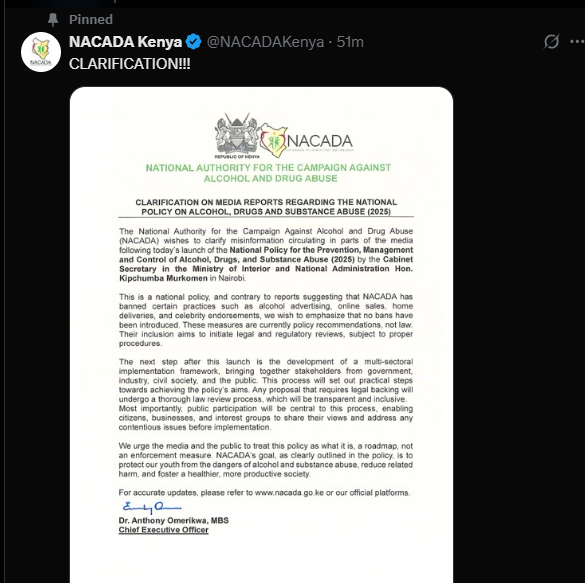
The agency urged the media and members of the public not to treat the policy as law but as a guide that outlines the direction Kenya hopes to take in addressing alcohol and drug abuse.
“We urge the media and the public to treat this policy as what it is, a roadmap, not an enforcement measure. NACADA’s goal, as clearly outlined in the policy, is to protect our youth from the dangers of alcohol and substance abuse, reduce related harm, and foster a healthier, more productive society,” the statement added.
Proposed policy
Although the policy has not yet been enforced as law, it outlines some bold proposals intended to curb rising substance abuse in the country.
If adopted, the policy would ban online alcohol sales and home deliveries. It also proposes that alcohol should no longer be sold in supermarkets, petrol stations, restaurants, residential areas, or near learning institutions.
The policy recommends raising the legal drinking age from 18 to 21. Under this proposal, anyone below 21 would not be allowed to enter alcohol-selling outlets, even when accompanied by adults. Anyone accompanied by a child or found carrying dangerous weapons would also be prohibited from purchasing alcohol.
Another significant proposal is the restriction on using public figures in alcohol advertisements. NACADA wants to ban the use of musicians, actors, athletes, media personalities, and influencers in promoting alcohol. Only individuals over the age of 25 would be allowed to appear in alcohol-related adverts.
The policy also seeks to end lifestyle marketing that portrays drinking as glamorous or aspirational. Advertising during watershed hours between 5:00 am and 10:00 pm would be banned across all platforms, including television, online content, and foreign broadcasts. Music videos, films, and performances that portray alcohol or substance use in a positive light would be restricted from appearing in print or electronic media.
The proposals go further to ban alcohol advertising or sponsorship of events that target individuals below the age of 21. Marketing alcohol at schools, universities, youth sports, entertainment shows, and arts competitions would also be banned. Outdoor alcohol advertising would face new rules, including a ban on billboards within 300 metres of schools, hospitals, residential areas, and government buildings.
The policy suggests that all alcohol advertisements should contain only factual information. They would not be allowed to promote the strength or supposed benefits of alcohol, dismiss abstinence, or link alcohol to a specific lifestyle.
Changes are also proposed to alcohol packaging. Manufacturers would be required to include clear health warnings and full ingredient lists. A minimum packaging size of 250 millilitres would be introduced in an effort to eliminate cheap, high-alcohol sachets and small bottles that are commonly consumed in informal settings.
Finally, the policy recommends that only the national government should have the power to issue licences for the manufacture, import, export, and distribution of alcohol. It also calls for tighter regulation of the number and location of alcohol outlets, especially in residential and educational areas.