Most Kenyans don’t report bribes over inaction fears, new report
By Nancy Marende, July 31, 2025A majority of Kenyans who encounter bribery do not report the incidents, primarily due to fears that no action will be taken, according to a new report by Transparency International Kenya.
The latest Kenya Bribery Index report, dated July 17, 2025, reveals that only 17 percent of those who found themselves in a bribery situation filed a formal report.
While this marks a slight improvement from 2019, when just 13 percent reported such incidents, the overall reporting rate remains significantly low.
“In this survey, only 17 percent of those who found themselves in a bribery situation made a formal report. This was, however, an improvement from the previous survey in 2019, when only 13 percent reported. This positive trend can be traced back to 2017, when only 6 percent reported,” Transparency International report reveals.
When asked why they chose not to report, respondents cited several reasons, including the belief that reporting would lead to no action. Others expressed fear of intimidation or retaliation, while some admitted they were beneficiaries of the bribe and thus had no incentive to come forward.
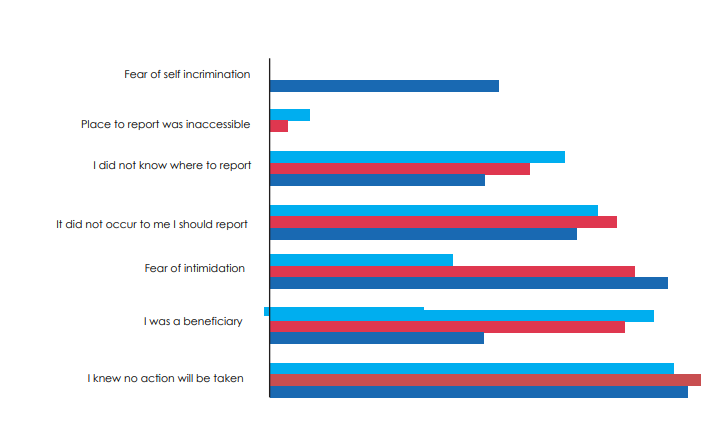
/X
The report also revealed that self-employed Kenyans have emerged as the leading givers of bribes, shedding light on the extent of corruption in everyday public service interactions.
The report reveals that 48% of individuals in the self-employed category admitted to paying bribes, the highest among all occupational groups surveyed.
The category was followed by the employed at 28 percent, the non-employed/student at 18 percent, and the retired at 6 per cent.
“The self-employed category registered the highest frequency of bribe paying at 48 percent. This ranking tallies with the previous survey in 2019, where the same category topped, albeit with a slightly lower magnitude of 45 percent,” read the report.
The report attributed this trend to the frequent interaction that self-employed individuals have with services prone to corruption, such as business licensing, regulatory compliance, and law enforcement.
It revealed that these interactions often expose them to more opportunities for bribery, either through coercion or to expedite service delivery.