Martha Koome launches Judiciary’s 4-year plan to tackle election disputes
By Mabonga Makhanu, July 21, 2025Chief Justice Martha Koome has officially launched the Judiciary Committee on Elections (JCE) Operational Plan 2025–2029 on Monday, July 21, 2025, signalling the Judiciary’s readiness to begin preparations for the 2027 General Election.
According to Martha Koome, the launch not only marks the transition of leadership within the JCE but also reaffirms the Judiciary’s vital role in safeguarding Kenya’s democracy through effective electoral dispute resolution.
During the event, Martha Koome also presided over the formal handover of leadership from the outgoing JCE chair, Justice Mohammed Ibrahim, to the incoming chair, Lady Justice Njoki Ndung’u. She described the moment as one that represents both continuity and renewal in the Judiciary’s institutional commitment to electoral justice.

With the launch of the 2025–2029 Operational Plan, Martha Koome emphasised that the Judiciary is laying down a clear roadmap towards the 2027 elections.
She said the plan serves not only as a preparation strategy but also as a framework for reinforcing the credibility, independence, and effectiveness of the electoral dispute resolution process.
“Today, I presided over the launch of the Judiciary Committee on Elections (JCE) Operational Plan 2025-2029 and the formal handover of leadership of the JCE from the outgoing committee, chaired by Justice Mohammed Ibrahim, to the incoming committee under the stewardship of Lady Justice Njoki Ndungu,” Koome said.
Milestones by JCE
Reflecting on the judiciary’s transformation over the years, Martha Koome acknowledged that Kenya has moved beyond an era when electoral disputes severely eroded public confidence in institutions.
She recalled the formation of the Judiciary Working Committee on Elections Preparations (JWCEP) in 2012, which later evolved into the permanent JCE, noting it as a decisive turning point in the Judiciary’s democratic journey.
Martha Koome also noted with pride that Kenya’s model of electoral dispute resolution has become an example across Africa, influencing judiciaries in countries such as Zambia and Malawi to adopt similar frameworks.
The implementation phase
Following the plan’s launch, Martha Koome confirmed that the new JCE will now begin the implementation phase, which includes developing work plans, conducting training for judges and judicial officers, pushing for timely legal reforms, and mobilising resources for the successful execution of the outlined activities.
She assured the incoming committee of the Judiciary leadership’s full support as they embark on the critical task of ensuring an effective and trusted EDR process in the 2027 cycle.
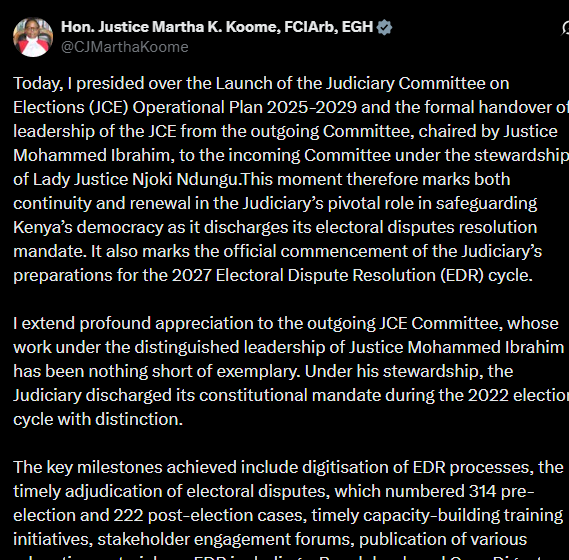
“The key milestones achieved include the digitisation of EDR processes; the timely adjudication of electoral disputes, which numbered 314 pre-election and 222 post-election cases; timely capacity-building training initiatives; stakeholder engagement forums; the publication of various educative materials on EDR, including a bench book and case digest; and the successful carrying out of post-election debriefs in a timely manner,” she added.