Malala drags Raila in Ruto and Murkomen’s shoot orders
By Aloys Michael, July 11, 2025The Democracy for the Citizens Party (DCP) has launched a stinging critique of Orange Democratic Movement (ODM) leader Raila Odinga, accusing him of hypocrisy and enabling the government’s violent suppression of recent Gen-Z-led protests.
With the 2027 general elections on the horizon, the DCP’s broadside against Odinga signals both a strategic positioning by the party and a warning shot to entrenched opposition figures who may be vulnerable to changing political tides.
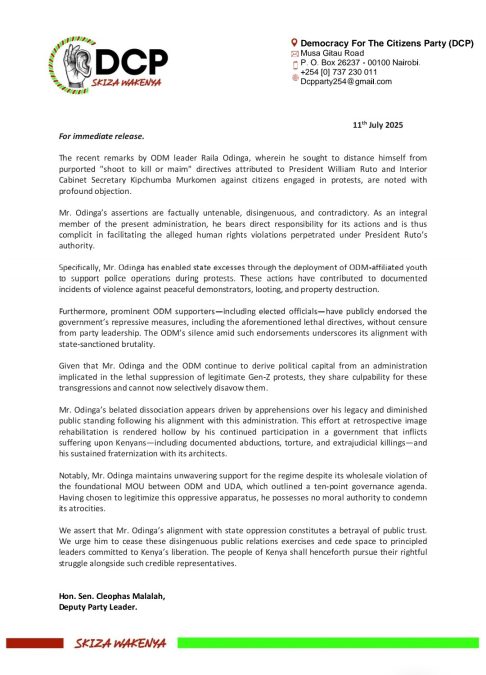
The accusations, delivered in a statement by DCP Deputy Party Leader Cleophas Malalah on Friday, July 11, 2025, underscore growing divisions within the opposition amid heightened political tensions.
At the centre of the controversy are remarks by Odinga seeking to distance himself from the government’s handling of the protests, particularly the use of lethal force reportedly authorised by Interior Cabinet Secretary Kipchumba Murkomen and President William Ruto.
At least dozens of demonstrators, many of them young, have been killed or injured since the unrest began.
Broad-based scrutiny?
Malalah rejected Odinga’s efforts to dissociate himself from the crackdown, describing them as politically expedient and historically revisionist.
“Mr. Odinga’s assertions are factually untenable, disingenuous, and contradictory. He remains an integral member of the present administration and therefore cannot absolve himself of its actions,” the statement read.
DCP’s statement accuses Odinga and the ODM party of playing an active role in what it described as state repression. Specifically, Malalah claimed that youth affiliated with ODM had supported police operations during the protests.
“His belated dissociation appears driven by apprehensions over his legacy and diminished public standing,” Malalah added.
This criticism comes amid mounting public discontent over how the Ruto administration has responded to a wave of youth-led demonstrations.
While the protests have largely focused on issues such as unemployment, taxation, and governance, the government’s response, widely condemned by rights groups, has brought renewed attention to Kenya’s legacy of police brutality.
The DCP argues that Odinga, historically a symbol of resistance and reform, has undermined his own political brand by entering into an alliance with President Ruto’s United Democratic Alliance (UDA). Their partnership, once anchored on a ten-point Memorandum of Understanding (MoU), is now viewed by critics as ineffective and politically costly for the former prime minister.
“Cede space to principled leaders committed to Kenya’s liberation,” the DCP said in its statement, warning that Odinga’s attempts at “image rehabilitation” would not erase his perceived complicity in what the party termed “an oppressive apparatus.”
Malalah highlighted a broader reconfiguration within Kenya’s opposition space, as new voices seek to capitalise on shifting public sentiment and the generational divide highlighted by the Gen-Z protests.
While Odinga has not formally scoffed at shoot-to-kill orders by the government’s security measures, DCP argue that silence from his camp amounts to tacit approval.
Malalah singled out the ODM leadership’s failure to condemn the use of excessive force, claiming it “underscores [ODM’s] alignment with state-sanctioned brutality.”