Justina Wamae faults Ruto for tea bonus drop
By Ascah Mwango, September 30, 2025Former Roots Party presidential running mate Justina Wamae has blamed President William Ruto for the sharp drop in tea farmers’ bonuses this year.
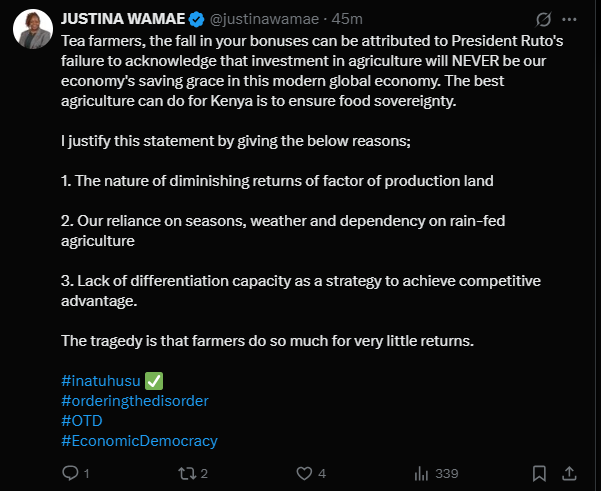
In a statement shared on her X account on Tuesday, September 30, 2025, Wamae said the decline is the result of the President’s failure to recognise that agriculture cannot be the backbone of Kenya’s economy in the modern global market.
Also watch: Justina Wamae announces plan to contest in 2027
She argued that the best agriculture can do is to ensure food security for the country.
Wamae said the challenges in agriculture are rooted in the diminishing returns on land, heavy reliance on seasonal weather and rain-fed farming, and the lack of differentiation that would give Kenyan tea a competitive advantage in the international market.
She criticised the situation, saying farmers put in immense effort but earn very little in return.
“Tea farmers, the fall in your bonuses can be attributed to President Ruto’s failure to acknowledge that investment in agriculture will NEVER be our economy’s saving grace in this modern global economy. The best agriculture can do for Kenya is to ensure food sovereignty. I justify this statement by giving the following reasons:”
Also watch: Justina Wamae says that free education and healthcare promises are unrealistic and bound to fail
“1. The nature of diminishing returns of the factor of production, land 2. Our reliance on seasons, weather and dependency on rain-fed agriculture 3. Lack of differentiation capacity as a strategy to achieve competitive advantage. The tragedy is that farmers do so much for very little return,” Wamae stated.
KTDA speaks
Her comments came as the Kenya Tea Development Agency (KTDA) moved to explain the reasons behind the reduced bonus payments for farmers.
In a press release on Monday, September 30, 2025, KTDA said the decline was largely due to unfavourable international market conditions and shifts in currency exchange rates.
The agency noted that in 2024, the Kenyan shilling traded at an average of Ksh144 to the US dollar, compared to an average of Ksh129 this year. The weaker exchange rate meant that even when international tea prices stayed steady, the amount realised in Kenyan shillings was much lower.
KTDA shared data showing the impact on earnings across different regions. In the East of the Rift Valley, Kiambu recorded Ksh371 per kilo, down by Ksh46 from last year. Murang’a earned Ksh376, a drop of Ksh42, while Nyeri received Ksh388, down Ksh42. Kirinyaga earned Ksh400, down Ksh38, Embu Ksh404, down Ksh34, and Meru Ksh381, down Ksh46.
The drop was sharper in the West of the Rift Valley. Kericho recorded Ksh245 per kilo, down by Ksh101, while Bomet received Ksh209, down by Ksh85. Nyamira earned Ksh266, a drop of Ksh106, Kisii Ksh246, down Ksh95, and Nandi and Vihiga Ksh208, down Ksh66.
KTDA explained that the differences in earnings between the East and West of the Rift Valley were due to quality variations, market preferences, and cost structures. Teas grown in high-altitude areas often fetch higher prices because of their desirable characteristics in the global market.
Weaker global demands
The agency added that some factories had also faced weaker global demand and rising operational costs, which further reduced net earnings. Independent producers and plantation companies outside KTDA in the western region experienced similar challenges, showing that the situation was market-driven rather than unique to KTDA.
KTDA urged farmers to avoid politicising the issue, warning that political interference in factory operations could harm them further. The agency encouraged farmers to focus on maintaining high-quality green leaf, ensuring disciplined factory management, and sticking to good agricultural practices.
KTDA said the final bonus is what remains after deducting monthly payments to farmers, as well as costs for processing, marketing, and logistics. While acknowledging that the payments were lower than expected, the agency emphasised that the outcome reflected global market conditions beyond its control.