IEBC registers only 7,048 new voters in the last 4 days
By Steve Ireri, October 3, 2025The Independent Electoral and Boundaries Commission (IEBC) has announced that only 7,048 new voters have been registered across the country in the four days since the relaunch of the Continuous Voter Registration (CVR) exercise on Monday, September 29, 2025.
In its latest update issued on Friday, October 3, 2025, the Commission said the registration drive, which excludes electoral areas preparing for the November 27 by-elections, has also seen 259 voters successfully transfer their details to preferred electoral areas, while eight voters updated their particulars.
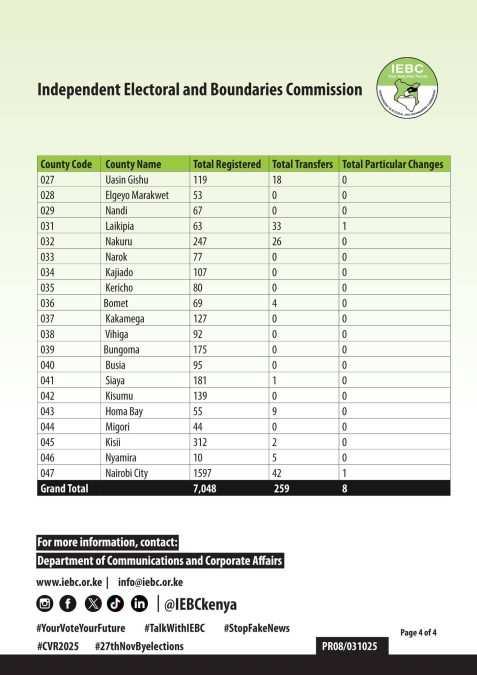
“In the last four (4) days since resumption, the Commission has recorded progressive growth in the enrolment of new voters into the Register of Voters. As of 2nd October 2025, new enrolments stood at 7,048, while those who successfully transferred their registration to their new preferred electoral areas were 259 voters. In addition, eight (8) voters updated their details nationally. A county-by-county breakdown of the registration statistics is annexed to this press release,” the IEBC presser noted.
Elsewhere, former nominated Senator Gloria Orwoba has criticised the IEBC for neglecting to prioritise Generation Z in its ongoing voter registration campaign.
New registered voters
IEBC noted that Nairobi recorded the highest enrolment with 1,597 new voters, followed by Mombasa with 556, Kisii with 312, and Kiambu with 386.
Other counties that registered relatively higher numbers include Kilifi with 243, Nakuru with 247, and Bungoma with 175, showing modest but consistent growth in regions that often play decisive roles in national politics.
Siaya also stood out with 181 new voters, with Mandera registering 218 and Garissa 160, underlining significant participation in parts of Northern Kenya that have sometimes struggled with low turnouts in registration exercises.
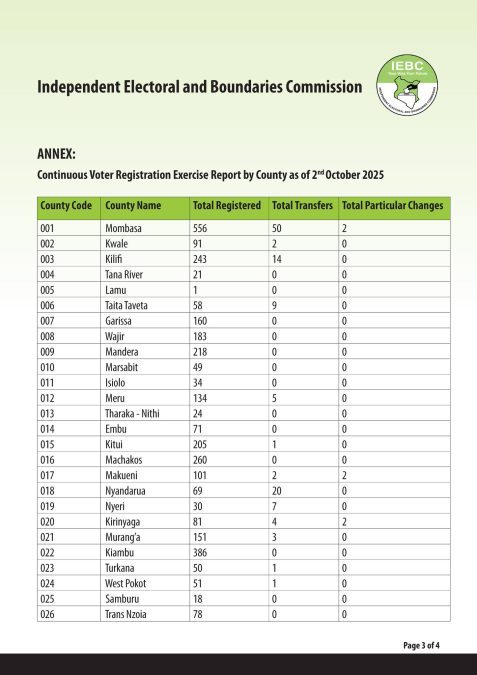
At the lower end of the spectrum, the Commission observed extremely small enrolments in counties such as Lamu, which managed to register only one new voter over the four-day period. Nyamira followed with just 10, Samburu with 18, and Tana River with 21, raising concerns about civic engagement in some of the smaller or more remote regions.
According to IEBC Chairperson Erastus Edung Ethekon, the CVR exercise remains critical in safeguarding democracy, and the Commission is urging more Kenyans, particularly young people and first-time voters, to take advantage of the opportunity to enrol.
“The IEBC calls upon all eligible citizens, particularly the youth and first-time voters, to take advantage of this opportunity and register as voters. Together, let us strengthen our democracy, safeguard our institutions, and secure the future of our nation.”
Biometric data
The Commission also announced a major enhancement in its registration system, with the inclusion of iris recognition as an additional biometric identifier.
Previously, the process only captured fingerprints and a digital facial photograph. The iris feature, IEBC explained, will serve as an alternative means of voter identification in cases where fingerprint recognition fails.
“In line with Section 2 of the Elections Act, Cap 7, the voter registration process entails the collection of both biographic information and biometric identifiers. Previously, the Commission captured fingerprints and a digital facial photograph as the only two biometric identifiers,” IEBC shared.
The inclusion is permitted under the Elections Act, which provides for a wide range of biometric identifiers including fingerprints, hand geometry, retina and iris patterns, voice waves, DNA, and signatures.
“The inclusion of iris recognition is expressly permissible under the law, which provides for biometric identifiers such as fingerprints, hand geometry, earlobe geometry, retina and iris patterns, voice waves, DNA, and signatures,” they added.

At the same time, IEBC reiterated its commitment to protecting personal data collected during the process.
It said that all information gathered will be stored securely, accessed only by authorised officers, and applied strictly for its legal purpose under the Data Protection Act, 2019.
Any breach or misuse of voter data, the Commission warned, will attract the full sanctions of the law.
“The Commission reiterates its strict compliance with the Data Protection Act, 2019, and its attendant regulations. All data collected during voter registration is securely stored, accessed solely by duly authorized officers and applied strictly for its legally prescribed purposes. The Commission emphasizes that any unauthorized access, misuse, or compromise of voter data will attract the full sanctions of the law,” the presser added.