DCI arrests TikToker for publishing false assassination claims online
By Steve Ireri, October 31, 2025Detectives have arrested a TikToker identified as Roy Otieno Odhiambo for publishing false information on his social media page, in a case that has reignited debate over Kenya’s tough new digital conduct law.
The Directorate of Criminal Investigations (DCI), in a statement on Friday, October 31, 2025, said the person of interest was apprehended in Malindi, following the circulation of a viral video posted on October 20, 2025, in which he claimed to have been paid Ksh3.5 million to assassinate a prominent individual.
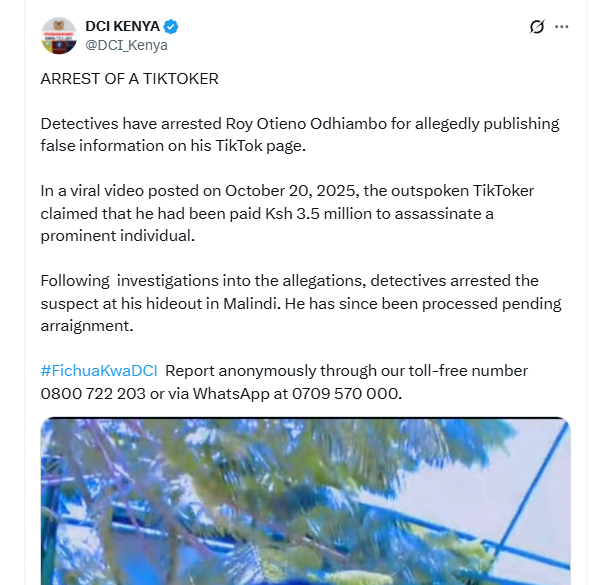
“Detectives have arrested Roy Otieno Odhiambo for allegedly publishing false information on his TikTok page. In a viral video posted on October 20, 2025, the outspoken TikToker claimed that he had been paid Ksh 3.5 million to assassinate a prominent individual,” DCI wrote.
DCI confirmed that following investigations into the video, the man was tracked down and taken into custody.
The agency termed the online content as false and misleading, warning that law enforcement will not hesitate to act against those who use social media to cause public alarm, spread misinformation, or damage reputations.
“Following investigations into the allegations, detectives arrested the suspect at his hideout in Malindi. He has since been processed pending arraignment,” DCI added.
Cybercrimes law
The arrest comes barely two weeks after President William Ruto signed into law the Computer Misuse and Cybercrimes (Amendment) Bill, 2024, which gives authorities new powers to curb the spread of harmful online content.
Also watch: Embu Catholic Church Backs Cybercrime Act, Citing Moral Responsibility
The new law, assented to on Wednesday, October 15, 2025, empowers investigative agencies and courts to order the removal of illegal content from websites, digital devices, or social media platforms, and even approve pre-emptive shutdowns if an online space is being used to promote criminal activity.
Under the newly introduced Section 46A, the government can now move to court to seek orders compelling offenders to delete offensive material or shut down their digital platforms before the content spreads.
The law criminalises a broad range of digital offences, including cyber impersonation, phishing, identity theft, unauthorised data access, and the spread of extremist material.