65% of Kenyans directly affected by Finance Bill 2025 – TIFA
By Nancy Marende, September 11, 2025Nearly two-thirds (65 per cent) of Kenyans say their personal or household financial situation has been directly impacted by the Finance Bill 2025.
This is according to a new survey by Trends and Insights for Africa (TIFA) released on Thursday, September 11, 2025.
The report shows that the burden of the bill is felt unevenly across the country, with the highest levels of impact reported in Coast (82 per cent) and Nyanza (81 per cent), while Northern Kenya recorded the lowest at 44 per cent.
Also Watch: Support for Ruto-Raila broad-based govt increases by 7 per cent – TIFA
Notably, Northern was the only region where a majority of respondents said they had not been affected, a finding TIFA attributes to the region’s relatively lower level of integration with the national economy.
“To fewer than half in Northern (44 per cent) – the only part of the country where a majority say they have not been impacted (for which refer to the earlier comment about its likely lower level of national economic integration),” read the report.
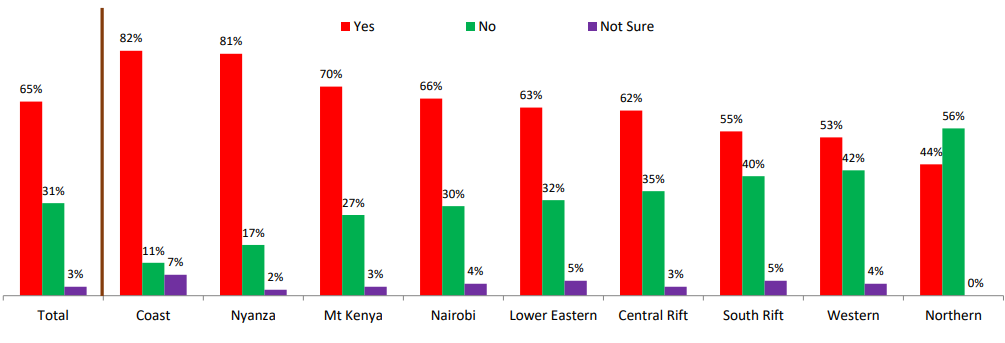
Among those who reported being affected, most cited negative consequences, ranging from higher taxes to reduced disposable income, with many noting overlapping effects such as increased cost of goods and reduced household spending power.
Also Watch: Finance Bill 2025: No new taxes, but what’s the catch?
According to TIFA, its researchers interviewed 2,023 randomly selected Kenyan adults across all 47 counties, capturing views on household economic realities, government policy, political alignment, and expectations ahead of the 2027 general election.
TIFA noted that subsequent political and economic developments may have influenced public opinion since the survey period; however, it stated that the results provide an accurate snapshot of Kenyan attitudes at the time.
Finance Bill 2025
The Finance Bill 2025 became law and took effect on July 1, 2025, following the assent by President William Ruto on June 26, 2025.
The act, which targets streamlining tax administration and increasing revenue collection, introduced key amendments to the Income Tax Act, the Stamp Duty Act, the Excise Duty Act, the Tax Procedures Act, and the Value Added Tax Act, which are expected to sustain revenue collection for the fiscal year 2025/26.
Among the amendments made is the Income Tax Act, which now mandates employers to apply all applicable reliefs, deductions, and exemptions to an employee automatically, as provided by the relevant law.
Under the law, private sector employers will now be required to pay their employees a daily subsistence allowance of Ksh10,000, which is tax exempt, a 400 per cent increase from the previous Ksh2,000.