Safaricom explains why police may be needed to recover wrongly sent M-Pesa money
By Steve Ireri, July 9, 2026Safaricom has explained why customers may be required to involve the police when trying to recover money mistakenly sent to the wrong M-Pesa number, clarifying that the telecommunications company cannot forcefully withdraw funds from a recipient’s account once they decline a reversal request.
The clarification follows growing concerns among M-Pesa users over the effectiveness of the platform’s reversal process, particularly in cases where recipients refuse to return money that was accidentally sent to them.
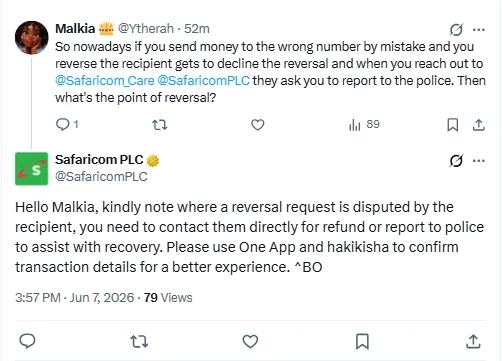
The issue gained widespread attention after an X user identified as Malkia questioned why Safaricom asks customers to report such cases to the police despite offering an M-Pesa reversal service.
According to the user, recipients are now able to reject reversal requests, leaving customers wondering whether the reversal feature still serves its intended purpose.
“So nowadays, if you send money to the wrong number by mistake and request a reversal, the recipient gets to decline it. Then, when you reach out to @Safaricom_Care or @SafaricomPLC, they ask you to report the matter to the police. So what’s the point of the reversal?” Malkia wrote.
Instead, the telco advised affected customers to first contact the recipient directly and request a refund before considering further action.
Where the recipient refuses to cooperate, Safaricom said customers should report the matter to the police, who can assist in the recovery process through the appropriate legal channels.
“Hello, Malkia. Kindly note that where a reversal request is disputed by the recipient, you need to contact them directly for a refund or report the matter to the police to assist with recovery,” the telco wrote.
The company also urged customers to take extra precautions before completing M-Pesa transactions by confirming recipient details using its available verification tools.
According to Safaricom, users should make use of the M-Pesa One App together with the “Hakikisha” confirmation feature, which displays the recipient’s name before money is sent, helping reduce the chances of sending funds to the wrong person.
“Please use the M-Pesa One App and the Hakikisha feature to confirm transaction details for a better experience,” Safaricom responded.
Why Safaricom cannot reverse disputed transactions
Safaricom’s explanation stems from the legal and regulatory framework governing mobile money services in Kenya.
While the company provides an automated reversal system for mistaken transactions, it does not have the legal authority to access or remove money from a customer’s account without their consent once a dispute arises.
When a customer initiates a reversal by forwarding the M-Pesa transaction message to 456 or using the MySafaricom App, the request is first processed through Safaricom’s internal system.
The recipient is then notified of the reversal request and given an opportunity to either accept or dispute it.
This safeguard exists to prevent fraud, such as situations where someone could deliberately send money as payment for goods or services and later attempt to reverse the transaction after receiving what they paid for.
/X
If the recipient insists that the money was legitimately sent to them, Safaricom cannot determine who is telling the truth.
Doing so would effectively require the company to act as both investigator and judge, roles that fall outside its legal mandate.
For this reason, once a reversal request is disputed, the matter shifts beyond an administrative process and may require intervention by law enforcement.
Police can formally investigate the circumstances surrounding the transaction, record the complaint, identify the recipient where necessary and pursue legal recovery if evidence shows the money was retained unlawfully.
Previous customer concerns
This is not the first time Safaricom has been forced to clarify how certain M-Pesa processes work following public concern.
The clarification came after customers questioned how the deductions were taking place.
“Good morning, @SafaricomPLC. Kindly explain how @_shakenya is able to deduct money from our M-Pesa accounts without prompting us to enter our PIN. This started happening after we registered for the SHA Lipa Mdogo Mdogo service. We need clarification on how this authorization works,” the X user wrote.
Safaricom explained that the transactions were linked to M-Pesa Ratiba, its standing order service, which allows users to authorise automatic recurring payments after granting prior consent.
Once that authorisation is in place, scheduled deductions can proceed without requiring a fresh PIN for every transaction.
“Hello, Collince. Apologies for that. If you have activated M-Pesa Ratiba, which is a standing order service on M-Pesa, and enabled SHA to auto-deduct, this can happen without prompting you to enter your PIN,” Safaricom stated.