KNEC explains how candidates can access primary and secondary school certificates online
By Katemarthason Okudo, July 31, 2026The Kenya National Examinations Council (KNEC) has outlined how candidates can access their examination certificates through its new e-certificate system, allowing users to obtain their documents digitally and organisations to verify their authenticity online.
The platform provides separate services for candidates seeking their certificates and organisations that need to confirm the validity of examination documents for purposes such as employment, admission or immigration.
How candidates can access e-certificates
Candidates seeking their examination certificates can begin by visiting the KNEC website and selecting the “e-certificate” tab. They can also access the dedicated e-certificate platform directly using the link provided by the examinations council.
Once on the platform, candidates are required to follow the instructions provided to access their examination certificates.
The electronic system is part of efforts to make examination documents easier to access while reducing dependence on physical certificates.
Organisations can register as certificate verifiers
Organisations seeking to verify examination certificates must first create an account on the platform. During registration, the organisation is required to select “Verifier Organisation” on the sign-up page and provide the requested details. It then selects “Send OTP”, after which a six-digit code is sent to the email address provided.
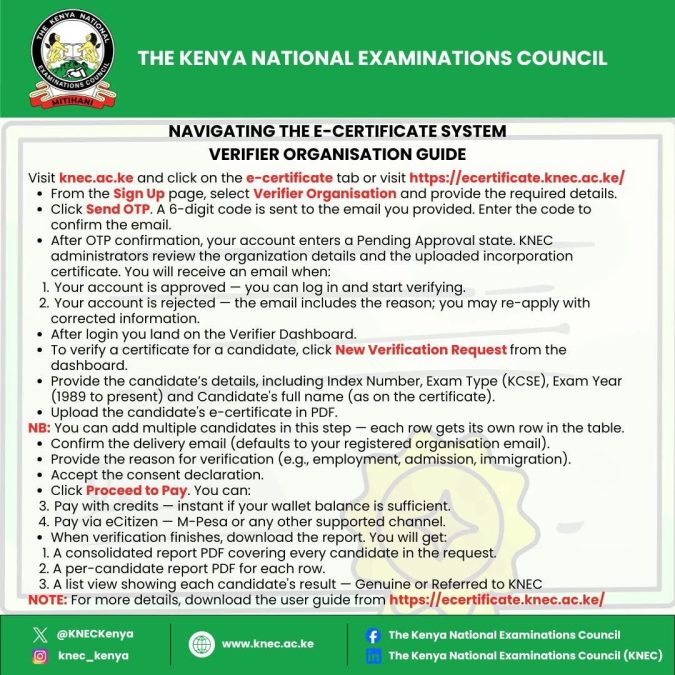
The code is entered on the platform to confirm the organisation’s email address. The application then moves to a “Pending Approval” stage as KNEC reviews the organisation’s information and uploaded certificate of incorporation.
Once the application is approved, the organisation receives an email notification and can log in to begin the verification process. “Your account is approved; you can log in and start verifying,” KNEC stated.
Where an application is rejected, the organisation receives an email explaining the reason. It can then correct the information and submit a fresh application.
Information required to verify a certificate
After approval, an organisation can access the Verifier Dashboard and select “New Verification Request” to begin checking a certificate. The verifier is required to provide the candidate’s index number, examination type, examination year, and full name exactly as they appear on the certificate.
The system covers KCSE examinations from 1989 to the present, according to the KNEC guide. The organisation must also upload the candidate’s e-certificate in PDF format as part of the verification request.
Multiple candidates can be included in a single request, with each candidate’s details entered in a separate row.
Payment required before verification
Before submitting the request, the verifier must confirm the email address where the verification results will be delivered and provide the reason for checking the certificate.
Reasons may include employment, admission, or immigration.
The organisation must also accept the consent declaration before proceeding to payment. KNEC allows users to pay using credits if their wallet has sufficient funds. Other available payment options include eCitizen, M-Pesa and other supported payment channels.
Verification reports available after processing
Once the verification process is completed, users can download the resulting reports from the platform. The system generates a consolidated report containing all candidates included in a request, as well as an individual report for each candidate.
The results also include a list indicating whether each candidate’s examination result is “Genuine” or “Referred to KNEC”, allowing organisations to identify certificates that require further attention from the examinations council.
The e-certificate system therefore provides candidates with a digital way of accessing their examination documents while giving organisations a structured process for confirming certificates without relying solely on physical copies.