Nadia Mukami’s ‘Single Mother’ is not just a song but a wake-up call
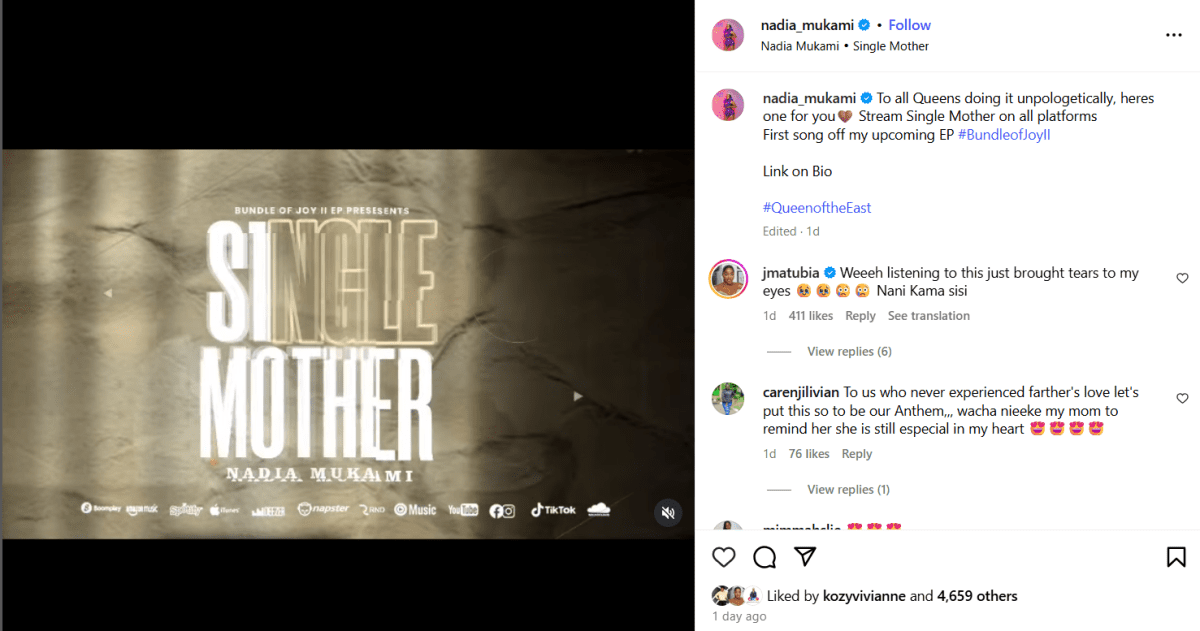
By Faith Lagat, July 18, 2025Kenyan singer and songwriter Nadia Mukami released her latest song ‘Single Mother’ on July 16, 2025 —a mellow yet powerful Afro-pop track that has already sparked intense public debate.
Within the first 48 hours, the song garnered 23,732 views across streaming platforms and social media, sparking conversations about single parenting, resilience, and shifting gender roles in modern Kenya.
Mukami, 29, is no stranger to weaving social issues into her music. Known for her soulful sound and relatable lyrics, the artiste has once again transformed personal stories into public dialogue.
In Single Mother, she highlights the struggles of women raising children alone, drawing direct inspiration from actress and media personality Jackie Matubia, 34, who has openly shared her own experiences as a single mother.
Matubia’s story
Jackie Matubia, famed for her role in the local television series Tahidi High, has spent much of 2025 in the headlines after publicly discussing her struggles with co-parenting and claiming neglect from her child’s father, actor Blessing Lung’aho.
Her story became a national talking point earlier this year when she detailed the challenges of balancing single motherhood with career demands. Some praised her for being vulnerable, while others accused her of recycling personal grievances for attention.

Despite the backlash, Matubia’s narrative reflects the reality of many Kenyan women. According to a 2021 University of Nairobi study, nearly 40% of households in Kenya are led by single parents. A 2020 survey by Canada’s McGill University found that 59.5% of Kenyan women are likely to become single mothers by age 45, often due to premarital births, union dissolutions, or abandonment.
A song rooted in reality
Mukami’s Single Mother captures this complex reality. The lyrics chronicle the emotional and financial burdens of single parenthood, including societal stigma, ridicule, and the daily grind of providing for children alone.
Yet, the song also carries a message of hope. It features a plot twist where the children of single mothers thrive academically and professionally, while their mothers eventually find love and personal fulfilment.
This optimistic framing aligns with recent findings from the Kenya Institute of Curriculum Development. A 2023 report noted that students from single-parent homes often perform just as well as their peers when raised in stable environments, challenging traditional assumptions about family structures.
Mukami’s decision to centre Matubia’s experience reflects a wider trend in Kenyan celebrity culture, where public figures are increasingly using their platforms to highlight social issues.
In a February 2024 interview with Pulse Kenya, Matubia declared, “I am a proud single mother,” calling for respect and dignity for women in her situation. She spoke openly about her two failed relationships and advocated for the normalisation of single motherhood without shame.
By translating this narrative into song, Mukami amplifies Matubia’s voice and pushes the conversation beyond gossip headlines into a broader dialogue about gender roles, parenting, and societal expectations.
While the song has been widely celebrated for its emotional depth, it has also stirred important questions: Beyond artistic tributes, what real support systems exist for single mothers in Kenya?
Economic pressures, social stigma, and absent fathers are contributing to the rise in single-parent households. Yet, little has changed structurally to address the challenges single mothers face. Affordable childcare, accessible healthcare, financial assistance, and workplace flexibility remain out of reach for many.
Beyond financial struggles and societal stigma, single mothers often face an invisible emotional toll rarely discussed in public forums—the constant pressure to embody both parental roles flawlessly. Many grapple with burnout from shouldering the full weight of caregiving, discipline, and emotional support without a partner to share the load.
This dual-role expectation not only strains mental health but also limits opportunities for personal growth, rest, and social connection, leaving single mothers vulnerable to isolation despite their resilience.
Mukami’s song doesn’t shy away from this reality but frames it through a lens of personal victory and societal resilience. However, some critics worry that glorifying perseverance without addressing systemic gaps risks normalising neglect from partners and institutions alike.
This duality is reflected in online debates, particularly on X, where reactions to both the song and Matubia’s disclosures remain divided. Posts praised the song’s tribute to single mothers. But others questioned whether the focus on personal success stories might overshadow the need for broader reforms.
Cultural shift in Kenyan music
Mukami’s Single Mother arrives at a time when Kenyan music is increasingly stepping into social commentary. Her Kai Wangu, released during her pregnancy, blended personal milestones with societal themes. The trend mirrors moves by other Kenyan artists, like Melissa Kariuki, who in 2025 became one of the first East Africans invited to the Recording Academy—a sign of regional growth in globally conscious artistry.
According to a 2023 Kenya Film Commission analysis, celebrities are more frequently using their influence to challenge taboos around gender equality, parenting, and mental health. Mukami’s latest single fits squarely within this cultural moment.
More than entertainment
For Mukami, the track represents a continuation of her artistic journey, blending melody with meaning. For Matubia, it’s a validation of her advocacy against stigma.
But for Kenya, the song is a mirror—reflecting both the progress in acknowledging single mothers’ contributions and the gaps that still need urgent attention.
As the conversation unfolds, one thing is clear: Single Mother is more than a song. It’s a wake-up call.