How GPS knows exactly where you are
By Dan Kauna, June 29, 2026Every morning, thousands of matatu drivers, digital taxi operators, and delivery riders across Kenya open navigation apps to beat traffic.
A tiny blue dot on a smartphone screen tells them where to turn, routes to avoid and how long it will take them to get to their destinations.
Yet, the actual mechanics of how a device talks to objects 20,000 kilometres away remains a mystery to most users.
Clocks, distances, and invisible signals
The Global Positioning System (GPS) does not track your phone; it is a one-way broadcast. Up in space, a dedicated group of at least 24 operational satellites orbits the earth twice a day.
Each satellite continuously loops a radio signal containing just two basic pieces of information: its exact location in space and the precise microsecond the signal left the satellite.
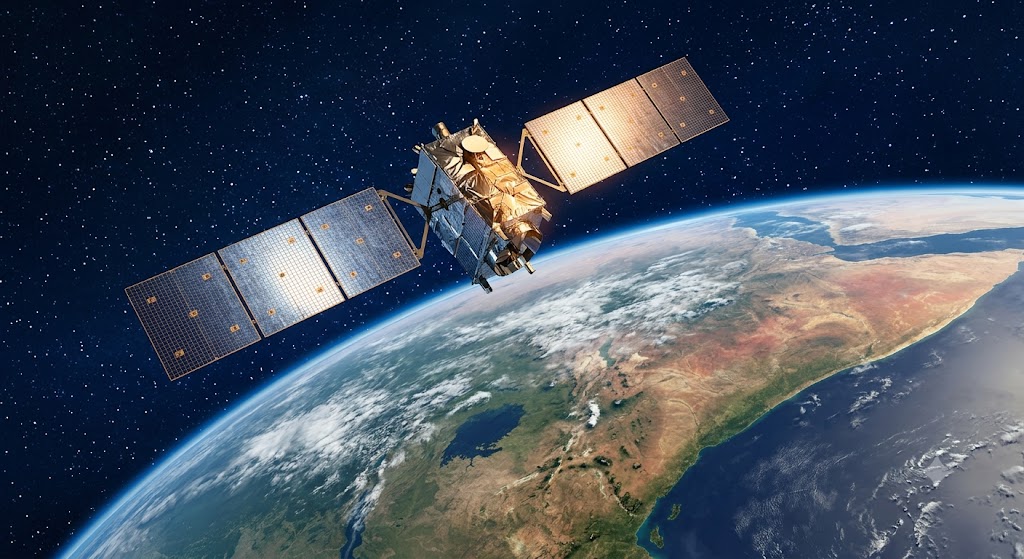
Because radio waves travel at the speed of light, your phone can calculate exactly how long the message took to arrive. By measuring the distance to four or more satellites simultaneously, the device uses a mathematical method called trilateration to lock onto your latitude, longitude, and height.
It is this precise geometry that allows a rider to spot an exact drop-off point.
The struggle with equatorial skies
Getting that signal from orbit down to a crowded street corner is rarely direct. The radio waves must pass through the ionosphere, a layer of charged particles in the upper atmosphere that slows down their transmission.
Because Kenya lies directly along the equator, these atmospheric disruptions are much more intense than in other parts of the world.

A peer-reviewed study published on ResearchGate titled Impact of Ionospheric Delay on GNSS in a Low-Latitude Region highlights this obstacle, noting that “the findings demonstrate that ionospheric delay remains a dominant source of error for GNSS users in equatorial regions.”
To handle this, your phone relies on pre-programmed mathematical models to adjust for the lag, bringing tracking errors down from dozens of metres to a tight radius of just a few steps.
Other minor delays happen when signals bounce off tall city skyscrapers before hitting your screen.